
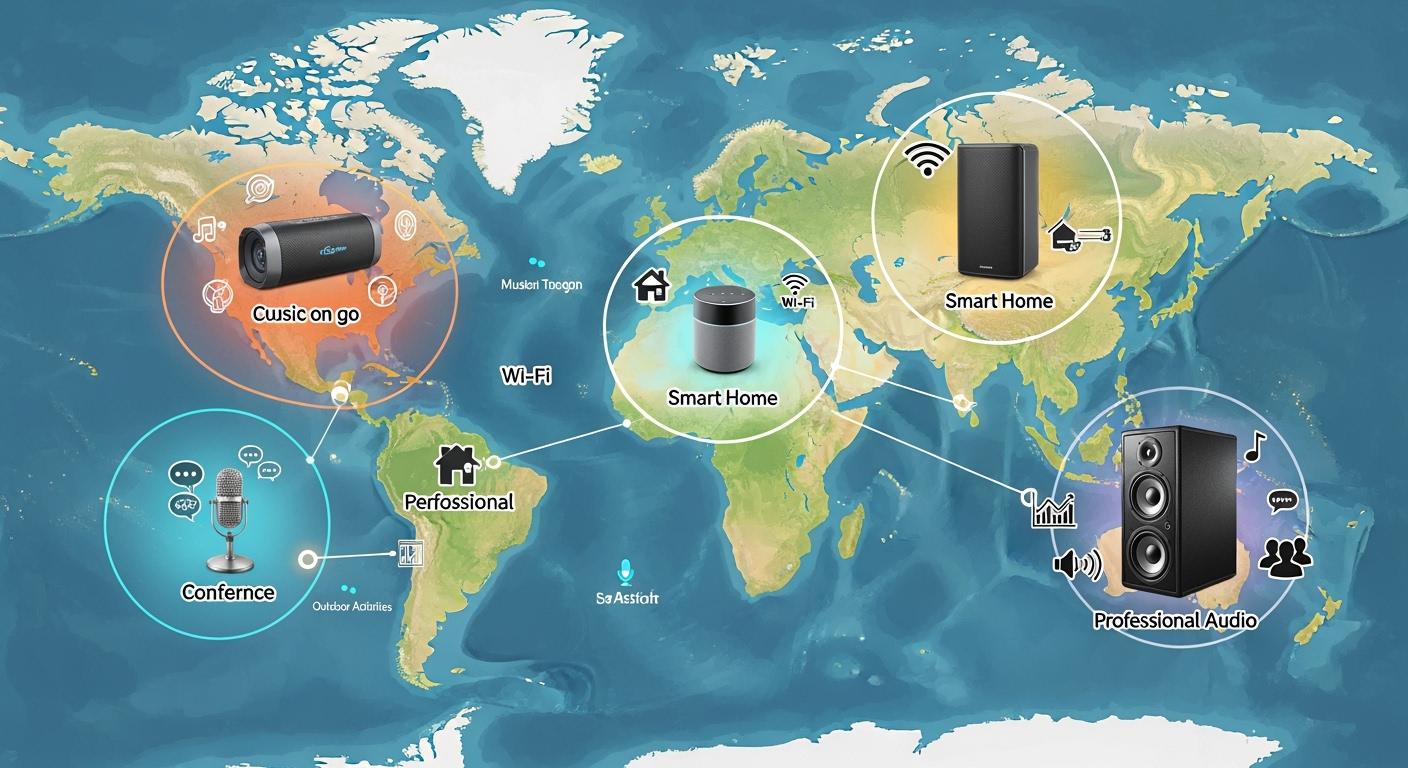
You see market demand differentiation for speakers in different regions because people want different things. Asia-Pacific has the biggest market because many people live there and more people are joining the middle class. North America does well because people use new technology and know a lot about products. Europe grows slowly because it is an older market. Latin America and the Middle East & Africa change fast because people’s tastes are changing. Market demand differentiation is important for businesses because what people like, how much money they have, and how they use technology affect their choices. For things like music streaming or smart home control, market demand differentiation shows steady needs. But for things like health monitoring and personalized education, market demand differentiation helps these new uses grow quickly. Market demand differentiation also depends on how much things cost, if they work well, and how fast people try new technology.
Region | Key Characteristics |
|---|---|
Asia-Pacific | Biggest market because many people live there and more people are joining the middle class. Main countries: China, India, Japan. |
North America | Led by the US and Canada; people use new technology and know a lot about products. |
Europe | Older market that is still growing; main countries are Germany, UK, and France. |
Latin America | Good market with more people wanting speakers in Brazil, Mexico, and Argentina. |
Middle East & Africa | Fast growth because more people are joining the middle class and people’s tastes are changing. |
Key Takeaways
Market demand for speakers is different in each region. Asia-Pacific is first because more people have money to spend. North America cares more about new technology.
What people like changes the market. In North America, people want smart features. In Asia-Pacific, people want cheaper choices.
Companies need to change their plans for each place. Knowing about local culture and money helps companies do well.
Smart home technology makes more people want speakers. People want devices that work with their smart home systems.
To make your business bigger, look at fast-growing places. Change your products to fit what local people want for better results.
Market Demand Differentiation: Regional Drivers

Key Factors Shaping Demand
Market growth for speakers depends on many things. Technology is very important. In North America and Asia-Pacific, people like smart home devices. They also use advanced audio systems. These regions adopt new technology fast. Room size and shape matter too. People set up speakers in different ways. Some want stereo sound. Others like surround sound for a better experience. Where you put speakers and how far apart they are changes the sound. This affects what speakers people buy.
Consumer preferences change market trends. In Asia-Pacific, more people can buy speakers because incomes are rising. This region has over 45% of the global market share. China, South Korea, and Japan are key countries. North America uses advanced driver technology in cars and electronics. Europe cares about premium audio and sustainability. In the Middle East & Africa, more people move to cities and earn more money. This makes demand go up.
Region | Key Characteristics |
|---|---|
Asia-Pacific | Has over 45% of the global market share; main countries are China, South Korea, and Japan. |
North America | Uses advanced driver technology in cars and electronics. |
Europe | Likes premium audio and cares about sustainability. |
Middle East & Africa | Markets are growing as more people move to cities and earn more money. |
Smart home ecosystems help the market grow. More homes use smart devices. This makes people want speakers that work with other devices. It creates new trends and pushes companies to make better products.
Impact on Business Strategies
Regional differences change business strategies. Companies must watch market growth and trends in each region. North America has high consumer awareness and strong brand loyalty. Businesses focus on innovation and use technology to attract buyers. In Europe, companies highlight quality and sustainability. They make premium products and use wireless and smart technology.
Asia-Pacific grows fastest. Urbanization, rising incomes, and more retail stores help this region grow. Companies must localize products and expand distribution. Latin America, the Middle East, and Africa grow steadily as infrastructure improves and tastes change. Businesses invest in localization, better distribution, and consumer education.
Region | Market Size (2024, USD Billion) | CAGR (%) | Key Demand Drivers and Business Strategy Implications |
|---|---|---|---|
North America | 10.5 | N/A | High consumer awareness, smart home tech adoption, mature retail and e-commerce, brand loyalty; strategies focus on innovation and using technology for tech-savvy buyers. |
Europe | 8.7 | 6.5 | Demand for premium audio, home renovations, design focus, wireless/smart tech adoption; strategies focus on innovation, sustainability, and quality. |
Asia Pacific | 7.2 | 9.2 | Fastest growth from urbanization, rising incomes, more retail stores, online shopping; strategies need localization and distribution expansion. |
Latin America & Middle East & Africa | 3.8 | N/A | Steady growth from better infrastructure and changing preferences; strategies include localization, distribution, and consumer education. |
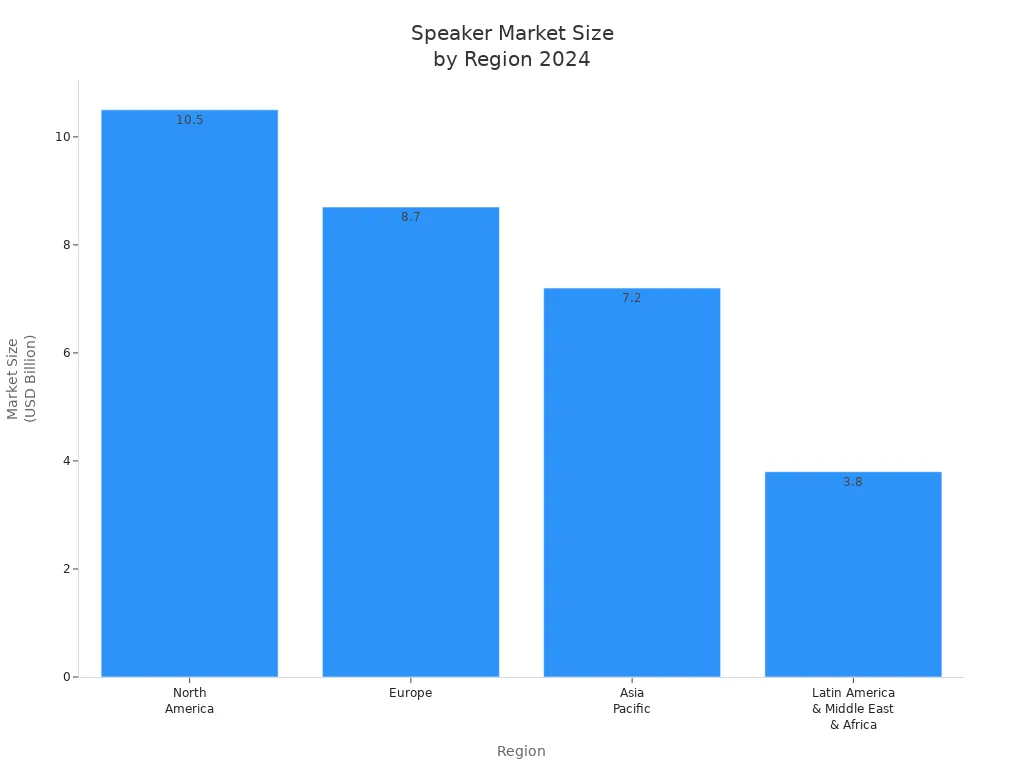
Companies use different strategies for each region. They use intelligence tools to study consumer behavior. They make products different by adding AI features and making them more sustainable. Companies use special data to develop products and target marketing for each region.
Tip: To succeed in the speaker market, always watch for new trends and change your strategy to fit each region.
Speaker Market Overview
Global Market Size and Growth
You can see the global speaker market growing quickly. The market size has increased a lot in recent years. In 2025, the global speaker market size will reach almost 50 billion dollars. By 2034, experts expect the market size to triple. This growth comes from more people using wireless and smart speakers. You can look at the table below to see how the global speaker market has changed over time.
Year | Market Size (USD million) | CAGR (%) | Key Trends |
|---|---|---|---|
2025 | 49,625.85 | 14.9 | Significant growth in wireless and smart speakers |
2034 | 150,704.39 | N/A | 1.2 billion Bluetooth speakers sold, 63% increase in wireless usage |
The global speaker market grows because people want better sound at home, at work, and on the go. You see more smart homes and more people using Bluetooth speakers. The global market size keeps rising as technology gets better and prices become more affordable.
Major Segments and Applications
You find many segments in the global speaker market. Each segment meets different needs. Some of the main segments include:
Home audio speakers: You use these for music, movies, and games at home.
Portable and wireless speakers: You carry these anywhere. They connect with your phone or tablet.
Professional and commercial speakers: You see these in schools, offices, and events.
Smart speakers: You use voice commands to play music or control smart devices.
The global speaker market also covers many applications. You use speakers for entertainment, education, business meetings, and even health care. The global demand for speakers grows as more people want smart features and better sound in every part of life.
Note: The global speaker market will keep changing as new technology appears and people find new ways to use speakers.
Factors Behind Regional Insights
Consumer Preferences
Consumer preferences are different in each region. In North America, people want the newest technology. They like fast updates and smart home features. Voice assistant is important to them. This is why North America has a big market share. In Asia-Pacific, more people use the internet now. Many people have higher incomes. People here want speakers that use local languages. They also want lower prices. In Germany, strict data rules matter. People pick products that keep their privacy safe. These differences show that what people want changes by region.
Economic and Technological Influences
Money and technology affect what people buy. The table below shows how this works in each region:
Region | Technological Influence | |
|---|---|---|
North America | High disposable income and early adoption of smart home technology drive the market. | Early adoption of technological advancements, particularly in smart speakers and voice assistant. |
Asia-Pacific | High population and expanding middle class create significant growth potential. | Growth in smart home technology adoption and voice assistant use. |
Europe | Established consumer electronics market with a strong focus on high-quality audio. | Focus on high-quality audio and integration with smart devices and voice assistant. |
North America tries new technology first. Smart speakers with voice assistant are popular there. Asia-Pacific grows fast because more people can buy new devices. People want smart home products. Europe cares about good sound and smart device use. These trends show how money and technology change what people want.
Regulatory and Cultural Factors
Rules and culture also change what people buy.
In North America, people have more money. They buy expensive speakers with voice assistant.
Europe is split. Western Europe likes luxury and good sound. Eastern Europe wants cheaper speakers and grows fast.
Asia-Pacific wants affordable, high-tech speakers, mostly in cities.
In Latin America, people want low-cost speakers. Brazil and Mexico are growing the most.
In the Middle East and Africa, culture matters a lot. Luxury speakers are popular in the Gulf States. Local customs affect what people choose.
Language and local features help brands connect with people. Companies that know your culture build trust. They make products that fit your needs. You see more speakers with voice assistant in your language. Features match your lifestyle.
Tip: When you shop for a speaker, think about your region’s culture, money, and technology. This helps you pick the best one for you.
Market Segmentation: Professional Speaker Market and More
Home Audio
Home audio systems are found in many homes. People want better sound for music and movies. They also want good sound for games. The global home audio equipment market will grow a lot. It will go from USD 32.8 billion in 2023 to USD 98.3 billion by 2033. The growth rate is 11.6%.
Asia Pacific has 35.8% of the market share. This is about USD 11.48 billion.
North America has a strong market. People spend more on luxury home entertainment.
Europe grows as more people use advanced audio technology. This happens in Germany, France, and the UK.
Smart speaker demand is rising. More people want voice control and easy connections. Families look for affordable smart speakers that fit their needs.
Portable and Wireless
Portable speaker demand keeps going up. People want to take music everywhere. So, they choose wireless speakers. In 2023, North America made up 29.55% of the global portable Bluetooth speaker market. People there use Bluetooth devices and love music. Asia Pacific leads with 37.54% of the market. Tech-savvy buyers want portable wireless speakers. Europe grows at a steady 11% rate. People want wireless convenience and good sound. In 2024, North America will have a 28.4% market share. Asia Pacific will dominate with 37.5%. Europe will have 24.8%. This growth happens as more people use smartphones and streaming services.
Professional and Commercial
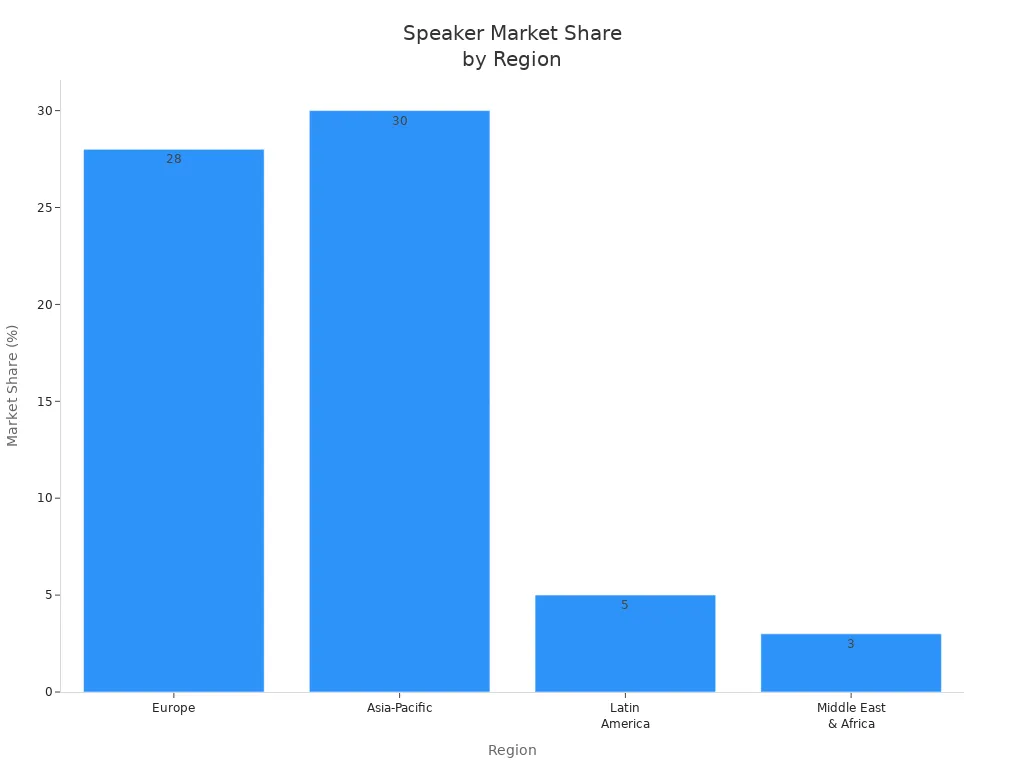
The professional speaker market covers many uses. You find these speakers in stadiums and schools. They are also in hotels and offices. The commercial segment includes cultural venues and sports events. It also covers business meetings. Asia-Pacific holds 30% of the market. Speakers are used in malls, banquet halls, and studios. Europe has 28%. It focuses on theaters, exhibitions, and corporate meetings. Latin America and the Middle East & Africa have smaller shares. They use speakers in music festivals, hotels, and mosques.
Region | Market Share | Key Application Areas |
|---|---|---|
Europe | 28% | Cultural venues, stadiums, performing arts centers, corporate meetings, theatrical productions, sports events, exhibitions. |
Asia-Pacific | 30% | Malls, stadiums, banquet halls, broadcast studios, educational campuses, weddings, corporate gatherings. |
Latin America | 5% | Music festivals, sports events, hospitality, tourism, corporate facilities, outdoor events. |
Middle East & Africa | 3% | Hotels, convention centers, mosques, entertainment complexes, luxury hospitality venues. |
Application Areas
You see professional speakers and commercial audio in many places. In North America, technology is used early in retail and hospitality. Europe focuses on research and customer engagement. Asia-Pacific grows fast in smart retail and entertainment. The professional speaker market supports commercial uses like stadiums, hotels, and schools. Commercial audio helps with events, meetings, and public spaces. Commercial applications grow as cities invest in smart solutions and better sound systems.
Region | Key Characteristics | Market Share Contribution | Growth Drivers |
|---|---|---|---|
North America | Early adoption of technology, strong retail and hospitality sectors, government investment | Over 30% | Investments in smart city initiatives and demand for localized audio solutions |
Europe | Similar to North America with a focus on R&D and favorable business environments | Over 30% | Strong emphasis on customer engagement and competitive advantage in saturated markets |
Asia-Pacific | Emerging market with rapid technological advancements and changing consumer preferences | Approximately 20% | Growth in smart retail and entertainment sectors, particularly in China and South Korea |
Tip: When you pick speakers for your home or business, think about how the professional speaker market and commercial audio can help you.
Regional Insights: Speaker Market Trends

North America
North America is the leader in the speaker market. In 2023, the market was worth USD 11 billion. The market grows fast because people use smart home devices. People also like advanced audio technology. Buyers want speakers with great sound and easy connections. Many people choose smart speakers with voice assistants. Companies work hard to make new products. They also care about brand loyalty. North America stays ahead by using new technology first.
Europe
Europe’s speaker market grows at a steady pace. The market will go from USD 4.53 billion in 2025 to USD 10.24 billion by 2034. The growth rate is 9.50% from 2026 to 2034. People in Europe like smart home systems and voice devices. They want hands-free ways to control things. Many people use smart speakers with other smart home devices. Some speakers have voice assistants that speak many languages. On-device AI helps keep privacy safe. Companies in Europe focus on making high-quality and eco-friendly speakers.
More people use smart home systems
People want hands-free control
Smart speakers connect with other smart devices
Asia-Pacific
Asia-Pacific is the fastest-growing speaker market. This region has many people and big cities. Governments help by supporting digital upgrades. China and India have strong demand for speakers. These countries also make new technology. More people buy affordable, high-tech speakers. Companies sell more products and make them fit local needs.
Many people live in cities
Governments support new technology
China and India have high demand
Latin America
Latin America’s speaker market is changing. There are new chances because of better infrastructure and local factories. Some problems are unstable money and hard shipping. Companies help buyers with payment plans and leasing. The market grows as more people want cheap speakers. Technology also gets better.
Better infrastructure
Local factories make speakers
Payment plans help buyers
Middle East & Africa
The Middle East & Africa are growing in different ways. More people buy electronics and have more money to spend. New buildings and better technology, like 5G, help the market. Cities grow, so more people want home entertainment. Rural areas still have lots of room to grow.
Growth Driver | Description |
|---|---|
Consumer Electronics Adoption | More people buy electronics, so they want speakers. |
Rising Disposable Incomes | People spend more money on audio products. |
Infrastructural Development | New projects make it easier to buy speakers. |
Technological Advancements | New things like 5G make people want better sound. |
Urbanization Trends | More people in cities want home entertainment. |
Untapped Market Potential | Rural places can grow a lot in the future. |
You can use these facts to learn about market trends. Asia-Pacific grows the fastest. North America and Europe are the biggest markets. Latin America and the Middle East & Africa have strong chances to grow.
Challenges and Opportunities by Region
Innovation and Product Differentiation
There are many new trends in the speaker market. Companies try hard to make their speakers special. Bluetooth wireless speakers now sound better and last longer. You can connect them to your devices easily. Smart technology, like voice assistants, makes speakers more helpful. You can ask your speaker to play music or answer questions. This makes things easier for you and helps companies make new ideas. Many brands use eco-friendly materials to protect the environment. They want to attract buyers who care about sustainability. Companies spend money on research and development. They want to make sound better and lower costs. Some use smart manufacturing to build speakers faster and better. These changes give you more choices and better products.
Supply Chain and Distribution
You may have problems when buying speakers from other regions. Supply chains can break and cause delays. This happens when parts come from many places. Sometimes, prices rise because shipping costs more. Trade rules and politics can change how speakers get to stores. Each region has its own rules for selling products. Companies must follow these rules, which can cost more money. Here are some common problems:
Supply chain breaks can cause delays and higher costs.
Geopolitical issues and trade changes affect product movement.
Different regions have special rules companies must follow.
Competitive Landscape
Many companies want to sell you speakers. Some focus on new technology. Others try to have the lowest price. You see big brands and small local companies. Each one wants you to trust them. Companies with smart features and eco-friendly materials stand out. They also make products that fit your needs in your area. You get better choices and prices because of this competition. If you watch the market, you can find speakers that fit your style and budget.
Practical Tips for Regional Markets
Adjusting to Local Demand
You need to know what people want in each area. In North America, people like smart speakers with voice helpers. In Asia-Pacific, many want affordable speakers that speak their language. Europe cares about good sound and being eco-friendly. Learn these preferences before making or selling your speakers.
Use surveys and market research to understand your customers. Visit stores and talk to buyers. See what features they care about most. Check online reviews and social media too. This helps you find trends early.
Tip: Always listen to your customers. Their feedback helps improve your products and find new markets.
Opportunities to Grow Your Business
You can expand by finding new markets. Start with fast-growing regions like Asia-Pacific or the Middle East & Africa. These areas have many new buyers. Look for gaps in the market. For example, some places need speakers for schools or public events.
Follow these steps:
Learn about the rules and culture in each region.
Partner with local companies who know the market.
Make products that fit local needs, like different languages or special designs.
Sell online to reach more customers.
Train your team to understand local trends.
Region | Example of a Key Strategy |
|---|---|
North America | Focus on smart features and updates |
Asia-Pacific | Offer affordable models with local languages |
Europe | Emphasize eco-friendly materials |
Latin America | Provide flexible payment options |
Middle East & Africa | Build trust through local partnerships |
You will find more chances to grow if you adapt quickly and stay open to change. Watch for new trends and always try to meet local needs.
You see that each region wants different speakers. Asia-Pacific grows fast because more people can buy new devices. North America and Europe lead with smart features and high quality. Latin America and the Middle East & Africa show strong growth. You need to study local trends to succeed.
Tip: Watch for new technology and listen to what buyers want. If you adapt your products, you can find more chances in the global market.
FAQ
What does regional analysis mean in the speaker market?
You use regional analysis to compare speaker demand in different areas. This helps you see what people want in each region. You can make better choices for your business when you understand these differences.
Why does regional growth matter for speaker companies?
You see regional growth when more people in an area buy speakers. This shows where the market is getting bigger. You can focus your efforts on these places to sell more products and grow your business.
How do you do market size estimation for speakers?
You estimate market size by looking at sales numbers, trends, and how many people want speakers. This helps you plan how many speakers to make and where to sell them. You can use this information to set goals.
What features do buyers want most in different regions?
You find that buyers in North America want smart features. In Asia-Pacific, people look for affordable prices and local languages. In Europe, buyers care about sound quality and eco-friendly materials. You should match your products to these needs.
How can you use regional insights to succeed?
You use regional insights to learn what works in each area. You can change your products or marketing to fit local tastes. This helps you reach more customers and build a stronger business.