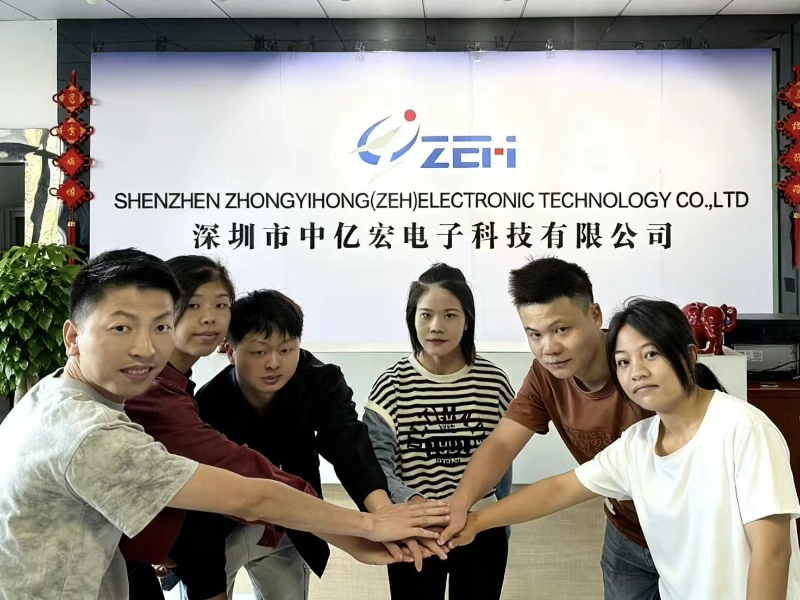
Founded in 1998 with its headquarters in Zhejiang Province, Shenzhen Zhongyi Hong (ZEH) specializes in the R&D, design, and manufacturing of full-range loudspeakers, backed by its independently developed core audio technology platform . Its product portfolio encompasses: small speaker, medium sized speaker, and large sized loudspeakers categorized by dimensions; full-range, automotive, and tweeter speakers classified by application and function; plastic speaker and metal speakers differentiated by material; and specialized audio drive components including vibration speakers, vibration motors, microphones, PCBA audio and audio amplifiers and Customize various products according to your requirements. .
Leveraging the manufacturing capabilities of its in-house plastic mold factory and CNC hardware mold workshop, ZEH has broken through acoustic performance bottlenecks via material innovation. It has simultaneously advanced the coordinated upgrading of diaphragm and magnetic circuit technologies , providing core support for product iteration and expanding its application scenarios across consumer electronics, automotive electronics, children’s products, medical devices, industrial instruments, home appliances, pet equipment, and smart homes.
Material Innovation: The Core Driver of Electroacoustic Breakthroughs
In electroacoustic technology, loudspeaker performance advancements have always centered on material innovation. As the core component of electroacoustic conversion, diaphragm material evolution epitomizes loudspeaker technological progress—from early natural materials like wood pulp to modern composites, engineers have relentlessly pursued balance in the “impossible triangle” of “high rigidity, high damping, and low mass” . Currently, mainstream diaphragm solutions fall into five primary categories:
- Traditional pulp-based materials: Optimize damping through blended papermaking with plant fibers ;
- Synthetic plastics (e.g., polypropylene): Offer moisture resistance and smooth sound reproduction ;
- Metals (e.g., aluminum, titanium): Ensure superior transient response via high rigidity ;
- Textiles (e.g., silk, linen): Impart soft mid-to-high frequency timbre ;
Bio-based materials: Emerge as a cutting-edge research direction .
Structural composites represent a more transformative innovation. For instance, three-layer sandwich diaphragms combine the light weight of pulp-based materials with metallic rigidity, while honeycomb structures achieve ultra-high strength-to-weight ratios through bionic design, effectively suppressing breakup vibration .
Material upgrades in magnetic circuit systems are equally critical. Research by enterprises such as Leien Chuangzhi Qiangci indicates that magnet materials directly determine a loudspeaker’s power response and distortion control . Three dominant technical routes have emerged in the market:
- AlNiCo magnets: Deliver stable magnetism for warm midrange, ideal for high-end Hi-Fi equipment ;
- Ferrite magnets: Dominate the consumer market due to cost advantages ;
- Neodymium-iron-boron (NdFeB) rare-earth magnets: Boast a high magnetic energy product of 1.0-1.4 Tesla (T), reducing volume by 70% compared to ferrite. Optimized via Grain-Boundary Diffusion (GBD) technology, they have become the preferred choice for consumer electronic terminals .
Case Study: Customized Solution for a German Client (2018)
In 2018, ZEH developed a tailor-made square plastic loudspeaker for a German customer, with clear core specifications: 65×65mm dimensions, 25W power, and 4Ω impedance. Adopting
NdFeB magnets and a dual-magnetic circuit design, the product delivered a significant boost in volume performance for the customer’s end products through its core design . Simultaneously, ZEH cut custom manufacturing costs by 20% via optimized material selection and production process integration.
Throughout project execution, ZEH strictly adhered to the delivery timeline to ensure on-time shipment, enabling the customer to align with market launch schedules and achieve projected sales targets. This collaboration’s professional execution and value delivery fostered a long-term partnership—today, the German client engages ZEH for annual custom projects, with product scope expanding from loudspeakers to supporting components like plastic enclosures and wire harnesses.
Enclosure Material Evolution: From Acoustic Adaptation to Multi-Scenario Compatibility
Loudspeaker enclosure materials have long transcended mere protection, becoming pivotal to sound optimization and scenario adaptation . According to technical documents from TEANMA, enclosure material evolution has undergone three revolutions:
- 1950s: Medium-Density Fiberboard (MDF) pushed resonance frequencies above 500Hz (an inaudible range for humans) with its homogeneous structure, reducing low-frequency distortion to below 8% ;
- 1980s: With the maturity of CNC technology, aluminum-magnesium alloy enclosures achieved total harmonic distortion as low as 0.01% through anodization and honeycomb design. The Finnish brand Genelec’s 8000 Series even pushed resonance peaks above 20kHz ;
- Present: Carbon fiber composites and PMMA (polymethyl methacrylate) have become new favorites. The former offers a damping coefficient three times higher than solid wood, while the latter creates a “cabinet resonance-free sound” experience via low-resonance properties .
Different scenarios demand tailored enclosure materials:
- Outdoor Bluetooth speakers: Adopt ABS engineering plastic with silicone protection to balance lightweight design, impact resistance, and waterproofing ;
- Professional monitoring equipment: Utilize CNC-machined aluminum enclosures and baffle-free designs to eliminate sound diffraction ;
- Home audio: Experiment with eco-friendly materials like bamboo fiber, balancing acoustic performance and sustainability .
Precise Matching of Power and Impedance: Scenario-Driven Parameter Design
The combination of power and impedance directly determines a loudspeaker’s compatibility and performance . Application data from leading manufacturers reveals distinct parameter designs for different scenarios:
- Portable devices (e.g., Bluetooth speakers): 40-52mm driver diameter, 3-20W rated power, and 4Ω impedance. High-sensitivity designs adapt to 3.7V lithium battery power, ensuring volume output at low energy consumption ;
- Desktop audio: 36-100mm large-diameter drivers, 15-50W power, and 8Ω impedance. Paired with external power supplies, they trade slightly lower sensitivity for reduced distortion .
Professional fields demand stricter parameters:
- Stage audio: Withstands over 100W rated power, using 8Ω dual-unit parallel designs to enhance load capacity ;
- Automotive audio: Optimized for 12V power systems, adopting 4Ω low-impedance units for stronger driving force ;
- Medical equipment: 2-30W power and high-impedance designs ensure stability and avoid electromagnetic interference .
Industry experts emphasize that power-impedance matching must follow the principle: the amplifier’s output impedance should be ≤ 1/8 of the loudspeaker’s impedance to balance efficiency and distortion .
Scenario Segmentation Spurs Customized Solutions
Material and parameter optimization ultimately serve precise adaptation to diverse application scenarios:
- Consumer electronics: Headphone and Bluetooth speaker drivers use NdFeB magnetic circuits and bio-fiber diaphragms to achieve wide-frequency response within a 5mm micro-size ; smart speakers integrate plastic enclosures and 4-8Ω impedance tuning for home voice interaction ;
- Professional fields: Studio monitors adopt aluminum enclosures and titanium diaphragms for sound reproduction with <0.01% distortion ; outdoor broadcasting systems use ferrite magnetic circuits and waterproof paper cones for stable operation at -20℃ to 80℃ ;
- Industrial/medical scenarios: Industrial alarms utilize horn-type structures and phenolic resin composite diaphragms for 300-meter sound transmission ; fetal heart monitors employ ceramic diaphragms and 1W low-power designs to ensure clear audio while avoiding electromagnetic interference .
With the development of IoT technology, smart loudspeakers with active noise cancellation are entering automotive and office scenarios. Their piezoelectric ceramic materials and adaptive impedance adjustment technology mark the entry of the loudspeaker industry into an intelligent new phase .