
You may think more speaker power always means louder sound, but that is not right. Many people think a speaker with 200 watts and an amplifier with 100 watts cannot be hurt. But, volume depends on more than just power. Room acoustics and speaker sensitivity matter a lot. Some companies use different ratings, which can confuse you. Music can also have peaks that go over the rated power and cause damage.
Key Takeaways
Speaker power ratings tell you how much energy a speaker can take. Always look at both power and sensitivity for the best sound.
Speakers with higher sensitivity make more sound using less power. Pick these if you want louder music without a bigger amplifier.
RMS power is very important for knowing how speakers work. Pay attention to this number so you do not break your speakers.
The way a room is set up changes how you hear sound. Put speakers in good spots to make sound clear and loud.
More power does not always mean the sound is louder. You need ten times more power to make the sound seem twice as loud.
Speaker Power Basics
Power Ratings Explained
When you look at speakers, you often see numbers like “100 watts” or “200 watts.” These numbers show the speaker power rating. Watts measure how much power a speaker can handle from an amplifier. If you use a speaker with too much power, you risk damaging it. If you use too little, you may not get the volume you want.
Speaker power is not the only thing that affects how loud your music sounds. Sensitivity also matters. Sensitivity tells you how much sound a speaker makes with a certain amount of power. For example, a speaker with a sensitivity of 90 dB, 1 W @ 1 m, will sound louder than one with 86 dB, 1 W @ 1 m, even if both use the same power. You can see that a speaker with higher sensitivity needs less power to reach the same volume.
Tip: Always check both the power rating and the sensitivity when you choose a speaker. This helps you find the right balance between loudness and safety.
RMS vs. Peak Power
You might see two different power numbers on a speaker box: RMS and peak power. These numbers tell you how much power the speaker can handle in different situations.
Term | Definition |
|---|---|
RMS Power | The amount of power a speaker can handle for a long time. This shows how well it performs over time. |
Peak Power | The highest power a speaker can take for a short moment, like during a loud drum hit. |
RMS (Root Mean Square) power is the most important number. It tells you how much power the speaker can handle without getting too hot or breaking. Peak power is only for quick bursts and does not show how the speaker will sound every day.
Manufacturers test RMS power by playing a steady sound and measuring the average power the speaker can handle. They test peak power by sending a strong signal for a short time to see the highest level the speaker can take.
When you pick a speaker, focus on the RMS power. This helps you match your amplifier and speaker for the best sound quality and safety. Remember, more speaker power does not always mean better sound. You need to look at all the numbers to make a smart choice.
How Speaker Power Affects Volume
Power and Loudness Relationship
Some people think doubling speaker power makes music twice as loud. This idea is not true. Our ears do not work that way. Human hearing reacts to sound in a special way called logarithmic. When you add more power, the volume does not go up quickly. You need much more power to hear a big change.
If a speaker plays at 50 watts and you use 100 watts, it will not sound twice as loud. You will only hear a small difference. To make a speaker sound twice as loud, you must use ten times more power. This happens because our ears measure loudness in decibels, not watts.
Note: Loudness is something you feel, not just a number. Your ears notice small changes in volume. Big jumps in power are needed for big jumps in loudness.
Decibels vs. Watts
Decibels and watts both measure sound, but they are not the same. Watts show how much energy goes to the speaker. Decibels show how loud the sound feels to you. The decibel scale is logarithmic. Each step means a bigger change than the last one.
Here is how you turn speaker power into decibels:
Use this formula: 10 x log10(power/reference power)
This formula shows that adding a few watts does not make a big change in decibels. For example, a sound at 80 dB feels much louder than 70 dB. The power difference is not huge. The Just-Noticeable Difference (JND) explains why your ears notice small changes in decibels more than changes in watts.
Measurement | What It Means | How It Affects You |
|---|---|---|
Watts | Energy sent to speaker | More watts can mean more volume, but not always louder |
Decibels | Loudness you hear | Small dB increases can feel much louder |
When picking speakers, look at both speaker power and sensitivity. Sensitivity tells you how loud a speaker gets with a certain amount of power. Speakers with higher sensitivity need less power to reach the same volume.
Diminishing Returns of More Power
Adding more speaker power does not always give you more volume. After a certain point, each extra watt helps less. This is called diminishing returns. If you keep adding power, you may not hear much difference. You could damage your speakers or cause distortion.
Amplifier power is important for reaching maximum volume. Too much power can break your speakers. Too little power can make your amplifier distort the sound. Matching speaker power with amplifier output is important for clear sound and safety.
Here are some best ways to match speaker power and amplifier output:
Match amplifier output to speaker power ratings to avoid distortion.
Align speaker impedance with amplifier impedance for safe operation.
Choose speakers with the right sensitivity for your needs.
Place speakers in the best spot to reduce distortion from reflections.
Tip: You do not need the biggest amplifier or the highest speaker power rating. Pick speakers that fit your room and your listening style. Higher sensitivity speakers can give you more volume with less power.
When you pick speakers, think about speaker power, sensitivity, and amplifier output. This helps you get clear sound and the right volume without hurting your equipment. You will enjoy music that sounds good and keeps your speakers safe.
Other Factors Influencing Volume
Speaker Sensitivity and Efficiency
Speaker sensitivity shows how well a speaker changes power into sound. You can find this number in decibels (dB) on the box. A bigger sensitivity number means you get more sound with less power. For example, a speaker with 90 dB sensitivity will play louder than one with 86 dB, even if both use the same power.
Speaker sensitivity tells how well a speaker turns power into sound.
High-sensitivity speakers need less power to get loud.
A 90 dB speaker makes 90 dB SPL at 1 meter with 1 watt.
High-sensitivity speakers work with small amplifiers.
Low-sensitivity speakers need more power to get loud, which helps in big or noisy rooms.
The formula ΔSPL = 10 × log10(P2 / P1) shows how power changes loudness.
When you pick speakers, check the sensitivity number. Make sure it fits your amplifier and room size. This helps you get good sound without wasting power.
Room Acoustics and Placement
The room changes how loud and clear your speakers sound. Hard walls, carpets, and furniture change how sound moves. How far you sit from the speakers also matters. Things you see in the room can change how you hear sound and how loud it feels.
Factor | Impact on Volume and Perception |
|---|---|
Distance to sound source | Changes how you hear loudness and space |
Visual cues in the room | Change how loud and deep the sound feels |
Late arriving sound energy (reflections) | Makes sound seem louder and changes how clear it is |
You can make sound better by putting your speakers and seat in a triangle. Keep speakers at least half a meter from the wall to stop bass problems. Try moving your speakers and listen for the best sound.
Speaker Design and Frequency
Speaker design changes how much sound you get for the same power. The box type, driver size, and how it is built all matter.
Sealed boxes give clean sound but less bass and are not as loud.
Ported boxes make more bass and play louder with the same power.
Bandpass boxes make strong bass in a small range but lose detail.
Transmission line boxes spread bass smoothly but are hard to build.
Open baffle speakers sound real but must be big for good bass.
Bigger boxes and drivers make deeper bass and more sound.
Bracing and damping inside the box cut noise and help sound.
Low notes need bigger drivers and more power to sound as loud as high notes. The box material and shape also change how much sound gets out and how clear it is. When you pick a speaker, think about your music and your space. This helps you match power, design, and sound for the best music.
Real-World Volume Scenarios
Comparing Different Power Ratings
You might wonder how different speakers perform when you change the power. Let’s look at two speakers in a simple test. Speaker 1 has a lower sensitivity, while Speaker 2 has a higher sensitivity. Both use the same amount of power, but their loudness is not the same.
Power (Watts) | Speaker 1 SPL (dB) | Speaker 2 SPL (dB) |
|---|---|---|
1 | 90 | 100 |
2 | 93 | 103 |
10 | 100 | 110 |
100 | 110 | 120 |
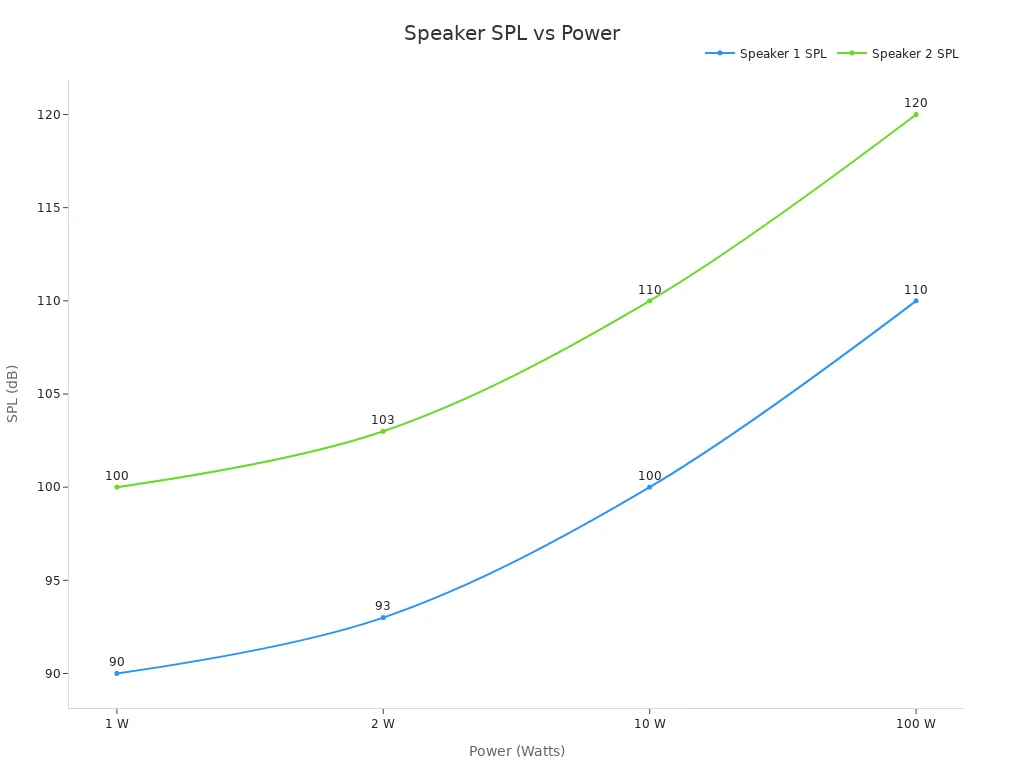
You can see that Speaker 2 always sounds louder than Speaker 1, even with the same power. This happens because Speaker 2 has higher sensitivity. If you want more volume without using a bigger amplifier, you should choose a speaker with higher sensitivity.
ZEH Audio uses advanced technology to match speaker power and sensitivity. Their engineers design speakers that give you strong sound with less energy. This means you get clear music and save power at the same time.
Sensitivity in Practice
In real life, you will notice that two speakers with the same power rating can sound very different. For example, a speaker with 250 watts and higher sensitivity can reach the same loudness as a 500 watt speaker with lower sensitivity. You do not need to double the power to get more volume if you pick a speaker with better efficiency.
When you use a speaker with high sensitivity, you need less power from your amplifier. This makes your setup easier and safer. You also get louder sound without pushing your equipment too hard. ZEH Audio helps you by offering custom solutions that fit your space and listening needs. Their team focuses on both power and sensitivity, so you get the best sound for your room.
Tip: Always check both the power rating and sensitivity when you choose speakers. This helps you find the right balance for your music and your space.
You have learned that speaker power is important for volume. But sensitivity, impedance, and design are also important. When you pick speakers, remember these things:
High sensitivity lets you get more sound with less power.
If you match amplifier power, speaker sensitivity, and impedance, music sounds clear and strong.
Good materials and smart design make sound better, not just high power numbers.
Do not choose speakers just because they have high peak wattage.
Audio engineers work to balance power, sensitivity, and room setup for the best sound. If you know these basics, you can choose well and enjoy music that fits your room.
FAQ
What does speaker power mean for volume?
Speaker power shows how much energy your speaker can handle. More power can help you get louder sound, but it does not always mean your music will sound twice as loud.
How does speaker sensitivity affect volume?
Speaker sensitivity tells you how loud your speaker gets with one watt. Higher sensitivity means you need less power for the same volume. You can save energy and still enjoy strong sound.
Does more power improve sound quality?
More power can help your speaker play louder without distortion. If you use too much power, you risk damaging your speaker. You should match your amplifier power to your speaker’s rating for clear sound.
How do I choose the right speaker for my room?
You should check both power and sensitivity. Pick a speaker with enough power for your space. Choose higher sensitivity if you want loud sound with a smaller amplifier.
Why is matching power and volume important?
Matching power and volume keeps your music clear and your equipment safe. If you use too little power, your sound may distort. If you use too much, you can break your speaker.