
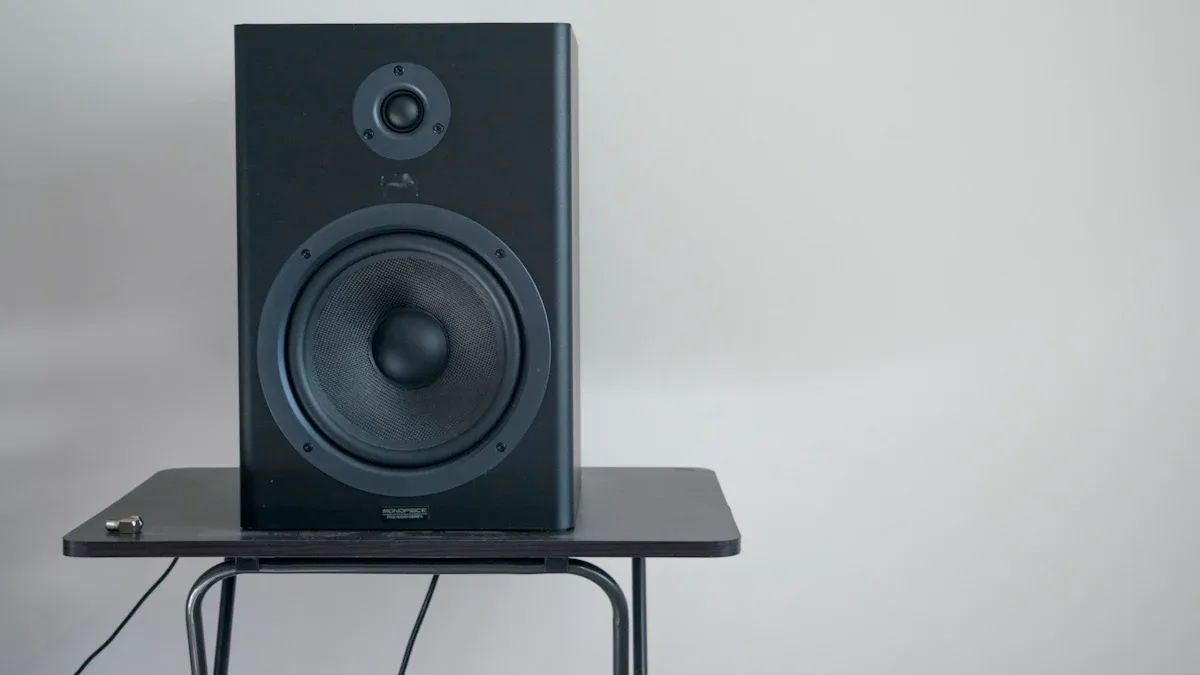
You choose speakers by matching their frequency response and design to your needs. Think about these important things:
Figure out where you will use the speakers and why.
Check what frequency range you need for good sound.
Pick the right kind of speaker for your use.
Think about how sound moves in your room.
Look at how sensitive the speakers are and how much power they need.
Decide how much money you want to spend.
Tip: Pay attention to the most important needs for your scene. This will help you choose the best speakers.
Key Takeaways
Figure out where you will use the speakers first. Different places like home, studio, or live shows need different speaker types and frequency responses.
Pick speakers with a frequency response from 20 Hz to 20,000 Hz. This range covers most sounds in music and movies.
Get speakers with a sensitivity rating over 90 dB. Higher sensitivity means the sound is louder with less power. This is good for big rooms.
Think about where you put your speakers. Try different spots to make the sound clear and balanced in your room.
Decide how much money you want to spend and do not go over it. Focus on the features that are most important for your needs to get the best deal.
Choose Speakers for Your Scene
You need to know where you will use speakers. Think about how you will use them. Each scene needs different frequency, coverage, and speaker type. Match your speakers to the place for best sound.
Home Audio
You want clear sound in your living room or home theater. Hard walls, floors, and ceilings can cause problems. These problems include:
Reverberation makes sound unclear.
Echo makes music or voices hard to hear.
Standing waves change bass levels.
Flutter echo makes a ringing noise.
To fix these, pick speakers with flat frequency response. This is usually from 40 Hz to 20,000 Hz. This covers most music and movies. For deep bass, add a subwoofer that goes down to 20 Hz.
Tip: Keep speakers away from walls and corners. Use rugs, curtains, or soft furniture to absorb sound and make it clearer.
For home audio, choose speakers for low, mid, and high frequencies. Floor-standing speakers cover all ranges. Bookshelf speakers are good for small rooms. Subwoofers play deep bass. Tweeters play high frequencies.
Studio Use
In a studio, you need speakers that show every detail. Studio monitors should have flat frequency response from 20 Hz to 20 kHz. This helps you hear your recordings clearly.
Sensitivity is important. Look for monitors rated around 90 dB SPL at 1 watt, measured at 1 meter.
Flatness matters. Smooth response means you can trust the sound.
For mixing, use nearfield monitors. Put them close to your ears to reduce room effects.
Choose speakers that cover the full frequency range. Use subwoofers for low sounds if you mix bass-heavy music. Midrange drivers and tweeters handle mids and highs. This helps you make good choices when recording or mixing.
Live Events
Live events need strong speakers for big spaces. Think about the size and shape of the venue.
Small venues use point source systems. These use several speakers aimed at different spots.
Large venues use line arrays. They send sound to the back and give strong bass.
Pick speakers with high sensitivity (95-110 dB) and enough power (40-100 watts RMS or more). Allow 10-15 dB of headroom to stop distortion.
Pick main speakers for mid and high frequencies. Use subwoofers for deep bass. For outdoor concerts, use weather-resistant models with high wattage. This makes sure everyone hears clear sound, even far away.
Note: Sound drops by about 6 dB every time you double the distance from the speaker. Plan your system so everyone can hear.
Indoor vs. Outdoor
Indoor and outdoor scenes have different problems. Indoors, sound bounces off walls and ceilings. Outdoors, there are fewer reflections but more noise.
Indoors, use standard speakers. Room shape and size change coverage, so move speakers for even sound.
Outdoors, use speakers with more power (at least 40 watts per channel) to beat noise. Pick models made for weather resistance and durability.
Here is a table of key factors for outdoor speaker selection:
Factor | Description |
|---|---|
Durability | Speakers must survive impacts and last a long time. |
Weather Resistance | Look for water-resistant and UV-protected materials. |
Sound Coverage | Make sure the power output reaches your audience without distortion. |
Acoustic Characteristics | Open spaces need careful placement for best sound. |
Regulatory Considerations | Follow local noise rules, especially in public places. |
Pick speakers that fit your scene. Indoors, focus on clarity and coverage. Outdoors, focus on power, durability, and weather resistance.
Tip: Test your setup before the event or installation. Move speakers and change settings to get the best sound for your space.
Frequency Response and Sensitivity
Understanding Frequency Range
When you pick speakers, you should know about frequency range. Frequency range tells you what sounds a speaker can make. Low frequencies give you deep bass. Mid frequencies are where most voices and instruments are. High frequencies make music and voices sound clear and sharp. If a speaker cannot play all these sounds well, you will not hear everything in your music or movie.
Frequency response is an important thing to check. It shows how well a speaker plays sounds from low to high. A balanced frequency response gives you true sound. This means you hear music and voices the way they were recorded. You do not get extra bass or lose high notes. If a speaker does not cover all the sounds, music may sound dull or too sharp. In studios or live events, a balanced response is even more important. You need to trust what you hear so you can do your job well.
Manufacturers test frequency response in special rooms called anechoic chambers. These rooms stop sound from bouncing off the walls. This way, the test only measures the speaker. Some companies use Near Field Scanner technology. This uses robots and computers to test speakers in normal rooms. It shows how speakers work with real-life effects. You can also look at frequency response graphs. These graphs show how loud a speaker is at each sound. Look for a flat line on the graph. This means the speaker plays all sounds at the same level.
Tip: Always look at the frequency response graph before you buy. A flat line means the sound is more accurate.
Ideal Frequency Response (20 Hz–20,000 Hz)
The best frequency response for most speakers is 20 Hz to 20,000 Hz. This is the range most people can hear. Deep bass starts at 20 Hz. The highest notes go up to 20,000 Hz. If a speaker covers this range, you will hear everything in your music, movies, or presentations.
Here is a table to help you learn about human hearing:
Aspect | Details |
|---|---|
Typical Hearing Range | 20 Hz to 20,000 Hz |
Sensitivity Range | Most sensitive between 2,000 and 5,000 Hz |
Age Impact | Hearing range gets smaller with age, starting around age 8, especially at higher frequencies |
Gender Differences | Men often lose high-frequency hearing faster than women |
Most people hear best between 2,000 and 5,000 Hz. As you get older, you may not hear high sounds as well. This happens to everyone. When you pick speakers, make sure they cover the whole range. Even if you cannot hear the highest or lowest notes, you still want full sound.
For different places, you may need to focus on some frequency ranges:
Home audio: Use speakers that cover the whole range for movies and music. Add a subwoofer for deep bass.
Studio use: Flat response from 20 Hz to 20,000 Hz is very important. You need to hear every detail.
Live events: Use main speakers for mids and highs, and subwoofers for bass. Line arrays help cover big spaces.
Outdoor events: Make sure your speakers can play low and high sounds, and have enough power for open spaces.
Note: If you want more bass, add a subwoofer. For clear voices and instruments, use midrange drivers. Tweeters play the highest notes.
Sensitivity Ratings (Above 90 dB)
Sensitivity tells you how loud a speaker gets with a certain amount of power. Manufacturers measure sensitivity in decibels (dB), usually at 1 watt of power and 1 meter away. A higher sensitivity rating means the speaker can play louder with less power.
Look for speakers with sensitivity ratings above 90 dB. These speakers are good and work well in most places. In live events or big rooms, high sensitivity is very important. You want everyone to hear clear sound without using too much power. In studios or at home, sensitivity still matters, but you may not need as much volume.
Here are some ways manufacturers test sensitivity and frequency response:
Frequency Response
Continuous Sweep
Acoustic Response
Loudspeaker Production Test
Stepped Frequency Sweep
Bandpass Frequency Sweep
Multitone
Transfer Function – White Noise signal
Transfer Function – Speech signal
Signal Analyzer (FFT) – White Noise
These tests help you compare different speakers. They show how a speaker works at different sounds and volumes. When you read the specs, look for both frequency response and sensitivity. This will help you pick the right speaker for your needs.
Tip: High sensitivity speakers save energy and do not need big amplifiers. This is good for both portable and fixed setups.
When you pick speakers for any place, always check the frequency response and sensitivity. These two things will help you get the best sound for your space, whether you want deep bass, clear voices, or sharp highs.
Speaker Types and Configuration
When you pick speakers, match their type and setup to your space. Each speaker type works best in certain places. You get better sound if you know how each one works.
Point Source vs. Line Array
Point source and line array speakers are used in many venues. Each has good and bad points. Look at the table below to compare them:
Feature | Point Source Speakers | Line Array Speakers |
|---|---|---|
Horizontal Coverage | Controls both directions well | Fixed horizontal, strong vertical control |
Expense | Costs less | Costs more, uses more modules |
Low-Frequency Control | Limited vertical pattern | Better vertical control, less reflection |
Setup Challenges | Needs skilled design to stop interference | Easier for even coverage |
Throw Distance | May not reach far without extra speakers | Even sound from front to back |
SPL Capability | Lower maximum volume | Higher volume for concerts |
Shallow Rooms | Can struggle | Not great for shallow rooms |
Use point source speakers in small rooms or when you need flexible placement. Line arrays are best for big events or concerts. They give even sound across large spaces.
Subwoofers and Satellites
Subwoofers and satellite speakers work together for full sound. Subwoofers play deep bass. Satellites play mids and highs. Filters like Linkwitz-Riley help each speaker do its job. This setup lowers distortion and makes sound clearer. You get a balanced system that covers all frequencies. This matters for music and speech.
If you need custom setups, companies like ZEH Audio can design systems that fit your needs. You get the right balance for your scene. This works for strong bass in clubs or clear speech in conferences.
Active vs. Passive
You must choose between active and passive speakers. The table below shows the main differences:
Category | Active Speakers | Passive Speakers |
|---|---|---|
Setup | Fast, simple cabling | More parts, careful matching |
Tuning | Built-in DSP and limiters | Needs external DSP and gain control |
Modularity | All-in-one, fewer upgrades | Easy to expand or upgrade |
Weight | Heavier cabinets | Lighter cabinets, heavier racks |
Scale | Good for small to medium events | Best for large, scalable systems |
Maintenance | One unit per speaker | Service amp or DSP separately |
Active speakers are easy to set up and tune. Passive speakers give more control and are better for big systems. If you want a custom solution, ZEH Audio offers advanced tuning and integration for both types.
Tip: Always match your speaker type and setup to your scene. This helps you get the best sound and value.
Room Acoustics and Placement
Room Shape and Size
You need to look at your room before you set up speakers. The shape and size of your space change how sound moves. Every room has its own sound. Large living rooms spread sound out, but they can also create echoes. Small rooms can make bass sound uneven. Square rooms often cause standing waves, which make some notes too loud or too quiet.
Experiment with speaker positions to find the best sound.
Use the equilateral triangle rule: Place your speakers and listening spot so they form a triangle with equal sides.
Notice how furniture, walls, and floors affect sound. Hard surfaces reflect sound, while soft items like rugs absorb it.
Each room needs a different setup. Try different placements to match your taste.
If you work in audio design or manage installations, always check the room first. Sketch the space and mark where people will sit. This helps you plan for even sound coverage.
Placement Tips
You can improve sound by changing where you put your speakers and seats.
In small rooms, move your seat away from the back wall. This gives you better bass and mid-bass.
Try less toe-in (angling speakers toward you) in small rooms. Sometimes, facing speakers straight ahead makes the sound feel bigger.
In rectangular rooms, placing speakers on the long wall increases the distance to side walls. This gives you a wider soundstage.
For square rooms, try putting speakers in the corners, facing the center. This can help balance low frequencies.
Tip: Always test your setup. Move speakers and seats a little at a time. Listen for changes in clarity and balance.
Acoustic Treatment
You can make any room sound better with the right treatment.
Place thick acoustic panels at the first reflection points. This reduces early echoes and makes sound clearer.
Put bass traps in the corners. These absorb extra bass and stop it from building up.
Treat the back wall with absorption panels or diffusers. This helps control reflections behind you.
Absorption panels act like sponges for sound. They cut down on echoes and make music or speech clearer. Diffusers scatter sound waves, so the room feels open and natural. Always look for standing waves, especially in small rooms. Fixing these problems gives you even bass and clear sound.
Note: You do not need a perfect room. Small changes, like adding a rug or moving a chair, can make a big difference.
Quality, Power, and Budget
Balancing Quality and Cost
You want speakers that sound great and fit your budget. Many buyers focus on value and trust what others say. You can use these habits to make smart choices:
73% of casual listeners check user reviews and ask friends for advice instead of reading technical specs.
65% of buyers prefer to spend less than $300 on audio equipment. They look for the best deal, not just the highest quality.
You should read reviews and compare products. Ask people you trust about their experience. If you need speakers for business or large projects, test samples before you buy in bulk. Always match your budget to your needs. High-end speakers work best for studios or big events. For home or small spaces, you can find good options at lower prices.
Tip: Focus on features that matter most for your scene. Do not pay extra for things you will not use.
Power and Headroom
Speaker power affects how loud and clear your sound will be. You need enough power for your space and audience. Headroom means your system can play louder than you need without distortion. This keeps your sound clean and safe.
Here is a table showing typical power ratings for different speaker types and distances:
Speaker Type | Distance | Power Rating (Wrms) |
|---|---|---|
Mains | 11ft | 40 |
Mains | 14ft | 63 |
Centre | 11ft | 63 |
Centre | 14ft | 100 |
Surrounds | 2ft | 20 |
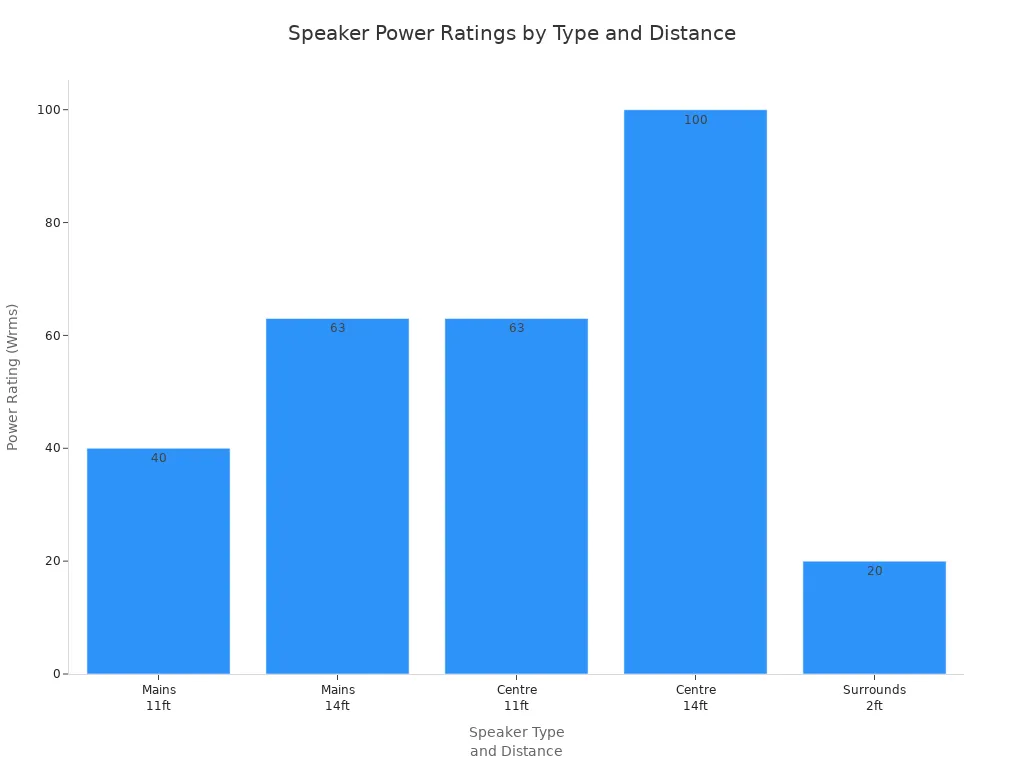
You should choose speakers with enough power for your room size and use. For live events or large rooms, pick higher wattage. For home or small studios, lower power works well.
Actionable Steps
You can follow these steps to make your final choice:
List your scene and main needs.
Set your budget and stick to it.
Check frequency response and sensitivity.
Choose the right speaker type and power.
Read reviews and test samples if possible.
Plan your placement and room treatment.
Confirm warranty and support options.
Note: You get the best results when you match your speakers to your scene, power needs, and budget. Take your time and choose wisely.
You pick the best speakers when you match them to your space, frequency response, sensitivity, speaker type, room sound, and how much you want to spend.
Pick coverage patterns that work with your room’s shape.
Think about headroom and how far you will sit to stop sound from getting fuzzy.
Try to keep sound levels close, within about 3 dB, so everything is clear.
Learn more by checking out these resources:
Title | Authors | Source |
|---|---|---|
Speech prosody supports speaker selection and auditory stream segregation in a multi-talker situation | Bregman, A. S. | MIT press |
Listening to one of two synchronous messages | Broadbent, D. E. | Journal of Experimental Psychology |
Follow these steps and use these resources to help you make good choices and get the best sound for what you need.
FAQ
What frequency response should you look for in speakers?
You should choose speakers with a frequency response from 20 Hz to 20,000 Hz. This covers the full range of human hearing and works for music, movies, and presentations.
How do you match speakers to different scenes?
You need to identify your environment first. For home audio, pick speakers with balanced sound. For studios, use monitors with flat response. For live events, select high-power models with wide coverage.
Why does speaker sensitivity matter?
Speaker sensitivity tells you how loud your speakers get with less power. You should look for ratings above 90 dB. High sensitivity helps you save energy and ensures clear sound in large spaces.
Should you choose active or passive speakers?
You should pick active speakers for easy setup and quick tuning. Passive speakers work best for custom installations and large venues. Your choice depends on your scene and technical needs.
How can you improve sound in your room?
You can add rugs, curtains, or acoustic panels to absorb echoes. Move your speakers and seats to find the best spot. Small changes help you get clearer sound and balanced bass.