
You can see lots of growth opportunities for smart device speakers. The market has big numbers:
It may reach $42 billion by 2030.
It could grow at a 21.30% rate each year from 2019 to 2030.
People want homes that are smarter. You notice new audio and wireless tech coming out. More people use new tech every year. The Internet of Things helps devices work together. You also like how easy it is to buy these products in many stores.
Key Takeaways
The smart speaker market will grow a lot. It may reach $42 billion by 2030. This happens because technology gets better and people want these devices.
Privacy worries and competition are problems for smart speaker companies. They must focus on user trust and special features.
AI improvements make smart speakers easier to use. They feel more personal and smart. This can help more people buy them.
Smart speakers can connect with other smart home devices using IoT. This makes using them simple and smooth. It helps more people want these technologies.
Voice commerce is becoming more popular. It gives an easy way to shop. This could help the smart speaker market grow a lot soon.
Smart speaker market challenges
The smart speaker market has some problems as it gets bigger. Sales and growth are not as fast as before 2021. In 2023, the market was worth $10.8 billion. It might grow to $105.5 billion by 2033. This means there is still a lot of room to grow. But privacy worries and not enough language choices make it tough for companies to get more users. Too many devices and similar products also make things hard for makers.
Commoditization and price pressure
Commoditization makes smart speakers look almost the same. Many brands sell products with the same features. Companies drop prices or sell bundles to win customers. This strong fight between brands cuts down profits. Problems in the supply chain and new rules add more costs. Makers have a hard time keeping their money steady. Platform fragmentation also makes it tough for devices to work together, so it is hard to stand out.
Tip: When you check smart speakers, try to find special features or better ways they work with your other devices.
Monetization issues
Many brands still have trouble making money. Companies look for new ways to earn besides selling devices. They try subscriptions, extra features, and working with other companies. But lots of people want basic services for free. This makes it hard for companies to earn more. High costs to follow rules and privacy worries also make it tough to make money. Makers need to come up with new ideas to add value and earn more.
Privacy and security risks
Privacy and security problems hurt the smart speaker market. People worry about ‘always-on’ microphones and how their data is used. Many users do not like their data being saved without asking. Surveys say 80% of people worry about privacy, and 90% think data misuse leads to ads that follow them. Trust in the maker changes if people want to use these devices. High costs to follow rules and local data laws make it harder to keep user data safe.
People worry about ‘always-on’ microphones
Data safety problems
High costs from local laws
People do not trust data protection
You know that privacy and security problems can slow down how many people buy smart speakers and how much money companies make.
Growth opportunities in smart speaker market
There are many ways the smart speaker market can grow. Technology keeps getting better. New features and better ways to connect with other devices give you more value. Here are the main things that help this market get bigger.
AI advancements
AI is changing how you use smart speakers. Voice assistants are now smarter. They understand you better and talk more like people. Companies use advanced AI to make things easier and more personal for you. Alexa+ uses AI to make your smart home feel more natural. Apple and Google also work on AI to make Siri and Google Assistant better. These changes help your smart speaker know what you like. It can answer your questions in a friendlier way.
Here is a table with some new AI features in smart speakers:
Advancement Type | Description |
|---|---|
AI-powered Smart Home Gadgets | AI, like Alexa+, makes your home more responsive and easier to control. |
Edge Computing in Consumer Electronics | New chips, such as AZ3, let your device process AI tasks faster without needing the cloud. |
Natural Language Processing Enhancements | AI now helps your speaker talk to you in a more natural and friendly way. |
You can see these new AI features:
Generative AI lets your speaker talk better.
Alexa+ remembers what you like for better answers.
Google’s Gemini AI makes your speaker more fun to use.
These AI upgrades make smart speakers more fun and helpful. This helps the market grow.
IoT and smart home integration
Smart speakers now work with many other devices in your house. The Internet of Things (IoT) lets you control things more easily. You can use your voice to turn on lights or change the temperature. You can even check your cameras. Smart speakers are the main hub for your smart home. You can manage everything with simple voice commands.
Here is a table that shows how IoT makes smart speakers better:
Evidence Description | Key Points |
|---|---|
AI-powered voice interfaces | You can control devices and settings based on your preferences. |
Growth in smart speaker ownership | More people buy smart speakers, leading to more smart home devices. |
Advanced ML algorithms | Features like facial recognition and predictive maintenance become possible. |
You can control lights, fridges, and coffee makers with your voice. Google Home and Amazon Alexa help you manage devices in different rooms. This easy connection gives the smart speaker market more chances to grow. More people want homes where everything works together.
Tip: Try linking your smart speaker to more devices. You will see how much easier your day can be.
Voice commerce potential
Voice commerce is growing fast in the smart speaker market. You can shop, order food, or pay bills just by talking. This makes shopping quicker and easier for you. The voice commerce market is getting bigger. Experts think it could reach $923.83 billion by 2040.
Here is a table showing how voice commerce might grow:
Year | Market Size (in Billion USD) | CAGR (%) |
|---|---|---|
2026 | 72.8 | N/A |
2040 | 923.83 | 19.90 |
More companies add voice shopping to their smart speakers. The global voice commerce market could grow by 24.6% each year from 2024 to 2030. This means you can shop and pay in easy, hands-free ways. As more people trust voice payments, the smart speaker market will grow even more.
Wireless connectivity demand
Wireless connectivity is another big reason the smart speaker market can grow. People want their devices to connect easily and work anywhere at home. New wireless tech, like Bluetooth 5.3 and Wi-Fi 6, makes smart speakers faster and more reliable. Over 40% of connected homes use smart speakers as part of their smart home setup.
Here is a table that shows how wireless connectivity helps:
Evidence | Details |
|---|---|
Market Growth | AI, IoT, and wireless tech drive the portable smart speaker market. |
Smart Home Ecosystems | 40% of connected homes use smart speakers as a central part. |
Consumer Preferences | 55% of buyers want portable and battery-efficient smart speakers. |
Connectivity Advancements | Bluetooth 5.3 and Wi-Fi 6 improve stability and device integration. |
You can connect your smart speaker to your phone or tablet with no trouble. Bluetooth helps you pair with many products. You do not need hard setups. This need for better wireless connections gives the smart speaker market more ways to grow.
Note: If your smart speaker will not connect, try updating its software or check your Wi-Fi.
AI, IoT, voice shopping, and wireless connections all help the smart speaker market grow. As these things get better, you will find more ways to use your smart speaker every day.
Market segmentation
Consumer vs. enterprise adoption
There are two main groups in the smart speaker market. Consumers use smart speakers for fun and help at home. They play music, ask questions, and control devices with their voice. Enterprises use smart speakers for special jobs. Some companies use them for health or learning. Not many businesses use smart speakers yet. Consumers use smart speakers more often than enterprises. Enterprises use them for certain tasks only.
Regional growth trends
Asia Pacific is growing fastest in the smart speaker market. The market size goes from $2.9 billion in 2024 to $15.2 billion by 2033. This region grows at a 24.1% rate each year. More people buy smart speakers as incomes rise and cities get bigger. Countries like China, Japan, South Korea, and India buy more smart speakers. Local brands sell cheaper speakers with local language features. Governments help by supporting digital and smart city projects. These things make the market grow quickly.
Demographic targeting
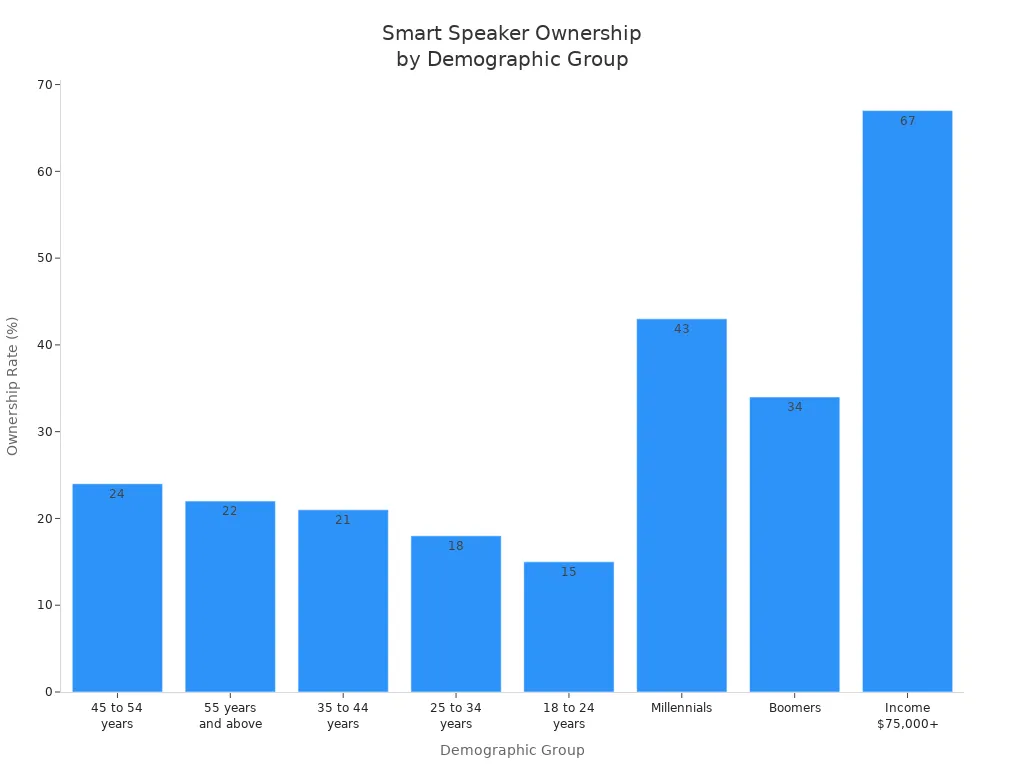
Targeting the right age and income groups helps the market grow. Middle-aged adults with higher incomes buy smart speakers more. Millennials and boomers also own many smart speakers. People who make over $75,000 are most likely to buy them. These groups use smart speakers for music, smart homes, and voice control. Success depends on good assistants, privacy, and easy use.
Here is a table with ways to market to these groups:
Strategy | Description |
|---|---|
Segment Ads by Age Demographic | Make ads that fit each age group’s needs and likes. |
Integrate Contextual and Behavioral Data | Use real-time data to show ads that match what users want. |
Use Clear, Voice-Activated CTAs | Add simple voice commands to help people buy things. |
Combine Smart Speaker Ads with Multi-Channel Marketing | Share ads on many channels to help people remember the brand. |
Test and Optimize Ad Frequency and Timing | Change how often ads show up so users do not get bored. |
Analyze Voice Interaction Data | Watch how people use their voices to make ads better. |
Focusing on the right people and places helps the smart speaker market grow faster.
Technology and innovation

Audio quality improvements
Smart speakers sound much better now. Companies add new sound features. Noise cancellation blocks out other sounds around you. Speakers can change their sound to fit your room. You can play music in every room at the same time. AI and machine learning help make the sound just for you. These changes help smart speakers stand out from others.
Better sound means music and voices are clearer.
Noise cancellation helps you listen without other noises.
Adaptive sound lets your speaker work in any room.
Multi-room audio lets you hear music all over your house.
AI and machine learning make the sound fit what you like.
You enjoy listening to music more every day.
Multi-modal interaction
Smart speakers use more than just your voice now. You can touch them, see lights, and hear sounds. When you press a button, you feel a click and hear a beep. This mix of senses shows your action worked. You do not have to wonder if your command went through. Multi-modal interaction makes smart speakers easier and more fun to use.
Using sound, touch, and lights gives you fast feedback.
Feeling a click and hearing a sound helps you know it worked.
This way makes things less confusing and helps you feel in charge.
Designers watch how you use these features to improve them.
More ways to use your speaker make it feel more natural.
These features make personal assistant technology more helpful in your life.
Ecosystem partnerships
Smart speakers get better when companies work together. Big brands team up to connect hardware, software, and AI. This teamwork helps smart speakers do more things and reach more people. When your speaker connects to smart home devices, it becomes the main hub in your house. This easy connection keeps you using your favorite brands.
Companies also work with cloud services, app makers, and device builders. These partnerships help smart speakers get made faster and work better. You get more choices and new features. The market grows as more devices work together. You also get a smart personal assistant that fits into your daily life.
Future outlook
Strategic recommendations
You can help the smart speaker market grow with smart plans. Companies spend money on research to make their products special. They add new things and make more types of smart speakers. Brands work hard so their devices connect better with others. Some companies make special products for different places. Trust is important, so companies promise to keep your data safe and listen to what you say.
Research helps make products different from others.
Adding cool features brings in more buyers.
Making devices work together helps users connect things.
Special products for each region get more people to buy.
Promising privacy and talking to customers keeps people loyal.
You see that working together, making new products, and joining with other companies also help the market grow.
Regulatory impacts
Rules change how the smart speaker market grows. New laws, like the EU Data Act, tell companies how to use your data. You get more power over your own information. Makers must let you get your data easily. These rules change how companies build and sell smart speakers.
Regulation | Key Changes | Impact on Smart Device Speakers |
|---|---|---|
EU Data Act | Gives users more control over their data | Companies must let users get their data easily |
Effective Date | 11 January 2024 | Companies must follow these rules by this date |
Access by Design | Products must be made for easy data access | Makers must plan for user data access from the start |
You get safer and clearer devices as companies follow these new rules.
Opportunities for developers
Developers are very important in the smart speaker market. You see new apps and features that make your smart speaker better. Voice UX design makes it easier to use your device. AI helps your speaker talk to you in a special way. Developers make apps for your home, shopping, health, and work.
Smart speakers help you control things at home.
Voice shopping gives you choices just for you.
Health apps help patients and doctors talk.
Work tools help you plan and find information.
You get more options and smarter features as developers create new things for smart speakers.
You can find lots of ways for smart device speakers to grow. Companies want to add cool features and use them in healthcare. They also try to sell in more places. You will see more companies working together and making security better. Makers and developers should build smarter and safer devices. They need to make speakers that feel more personal. New ideas in AI, IoT, and green materials will help the market get bigger. You will get speakers that fit your life and help you each day.
FAQ
What are smart device speakers?
You use smart device speakers to play music, answer questions, and control your home. These speakers connect to the internet and respond to your voice. You can ask them to set reminders or check the weather.
How do smart speakers help your daily life?
Smart speakers make your day easier. You can turn on lights, play music, or get news updates with your voice. You save time and enjoy more comfort at home.
Are smart speakers safe to use?
You need to check privacy settings. Most brands offer options to protect your data. You can mute microphones or delete voice history. Always update your device for better security.
Tip: Review privacy policies before you buy a smart speaker.
What features should you look for in a smart speaker?
You should look for clear sound, easy setup, and good voice recognition. Some speakers work with many devices. Choose one that fits your needs and connects well with your smart home.
How big is the smart speaker market?
The market keeps growing as more people buy smart speakers. You see new features and better technology every year. Companies add smart home integration and voice shopping to attract buyers.