
Sound reflections in a room significantly impact how clear and deep music sounds. Direct sound makes music feel close and detailed, while early reflections provide a sense of space but can sometimes cause sounds to mix together or alter their tone. Late reflections turn into reverberation, which can diminish the clarity of the music.
Type of Reflection | Contribution to Listening Experience |
|---|---|
Direct Sound | This is the loudest sound you hear. It gives clarity and makes music feel close. |
Early Reflections | These add a feeling of space and distance. They work best if they come within 15ms-100ms. |
Late Reflections | These sound like reverberation. If too strong, they can make music less clear. |
To optimize sound quality, you can enhance your music experience by managing these reflections. ZEH Audio employs specialized acoustic design to help you achieve the best sound in any room.
Key Takeaways
Direct sound helps you hear music clearly. Put your speakers in the right spot to get more direct sound and better listening.
Control early reflections to make your music feel bigger. Put acoustic panels where sound bounces off to make it sound better.
Try to have fewer late reflections and less echo so the sound is not messy. Use both absorption and diffusion to keep the sound clear.
Use easy tools like the mirror trick and sound apps to find where sound problems are in your room.
Try moving your speakers and changing your room to see what sounds best for you.
Sound Reflections and Speaker Quality
Direct Reflections Explained
Direct sound goes straight from the speakers to your ears. You hear this sound before anything else. It gives you the clearest and most true audio. If you sit in the right spot, you can notice small details. You also hear where sounds are coming from. Scientists say direct sound helps your brain tell apart voices and instruments. If strong reflections from walls or ceilings come soon after, they can mix with the direct sound. This mixing can make it hard to hear details.
Direct sound comes first and makes things clear.
Reflected sound comes later and can make things blurry.
Strong reflections might make your brain mix sounds together.
Early Reflections’ Benefits
Early reflections reach your ears 50 to 100 milliseconds after direct sound. These bounce off walls, floors, or ceilings nearby. They make music feel bigger and more real. When early reflections blend well with direct sound, you hear a fuller sound. The music feels more interesting. Audio engineers say early reflections, if controlled, help you hear both detail and depth.
Type of Sound Reflection | Effect on Sound Quality |
|---|---|
Direct Sound | Beneficial |
Early Reflections | Beneficial |
Late Reflections | Detrimental |
Early reflections work best when they sound like the direct sound. ZEH Audio makes speaker systems that control these reflections. This helps you get the best sound in your room.
Late Reflections and Reverberation
Late reflections come much later than early ones. You hear them as echoes or as reverberation. Too much reverberation can make music and speech sound messy. You might have trouble understanding words or hearing instruments. In rooms with too many late reflections, you lose important details. Good concert halls keep a balance between clear sound and reverberation. Most rooms do not have this balance.
Too much reverberation makes things less clear.
Too many late reflections make speech and music blurry.
You might miss details if the room is too echoey.
To get the best sound, you need to control late reflections and reverberation. This lets you enjoy clear and detailed sound from your speakers.
Types of Reflections in Rooms
Identifying Reflection Points
You can find where sound bounces in your room with easy tricks. The “mirror trick” is a simple way to do this. Sit where you usually listen to music. Have a friend move a mirror along the wall at your ear height. When you see the speaker in the mirror, that is a reflection point. These spots are where sound hits the wall and then reaches your ears right after the direct sound. If you put absorption panels on these spots, you can cut down on echoes and make the sound better.
You can also use listening tests to help. Play music and walk around the room. Listen for places where the sound gets muddy or hard to hear. These spots often have strong reflections. If you want to be more exact, you can use Room EQ Wizard (REW) and a special microphone. This tool shows you how sound moves in your room and helps you find problem spots.
Tip: Reflection points are not just tiny dots. They can cover bigger areas on the walls, ceiling, or even the floor. Treating a larger area works better.
Diffraction and Resonance Effects
The shape of your room and what it is made of change how sound moves. Hard things like glass or concrete bounce sound back and make echoes. Soft things like carpets or curtains soak up sound and make the room quieter. Echo happens when sound bounces off hard things and mixes together, making it hard to hear clearly.
Diffraction lets sound go around things or through holes. Low sounds bend more than high sounds. This means bass can reach you even if something is in the way. Resonance happens when sound bounces between walls, floors, or ceilings. This can make some notes sound louder or last longer. Both resonance and diffraction change how you hear music in your room.
Factor | Effect on Sound Reflections |
|---|---|
Room size and shape | Bigger rooms have longer echoes. Odd shapes spread sound out. |
Surface materials | Hard things bounce sound; soft things soak it up. |
Diffraction | Sound bends around stuff, changing how you hear it. |
Resonance | Some notes get louder or last longer in the room. |
If you know about these effects, you can make your speakers sound better. ZEH Audio uses smart design to control these things and give you clear, balanced sound in any room.
Room Acoustic Assessment
Spotting Problem Areas
You can start to assess your room’s acoustics by listening carefully. Sit in your main listening spot and play music you know well. Move around the room and notice where the sound changes. If you hear music that sounds muddy, harsh, or unclear, you have found a problem area. You might also hear echoes or certain notes that sound too loud. These are signs of strong reflections or resonance.
Tip: Try clapping your hands once in different spots. Listen for a sharp echo or a long ringing sound. A quick, clean clap means your room has fewer problems. A long, messy echo means you need to treat the room.
To optimize sound quality, you need to find the best spot for your speakers and your listening position. Start by measuring the distance from the speakers to the front and side walls. Move your speakers and seat until you hear a balanced sound. This step helps you get a smooth low-frequency response.
Using Simple Tools
You can use simple tools to check your room’s acoustics. Many free or low-cost apps help you measure sound reflections and reverberation. OpeNoise is an open-source app that shows real-time sound data. It works well for basic room checks, especially with an external microphone. The Nureva App lets you measure background noise and reverberation using your phone or tablet. It gives you a score and guides you through the process, even using a balloon pop to test echoes.
If you want more detail, use a measurement microphone with a flat frequency response. Pair it with software like Room EQ Wizard (REW). This software generates test signals and measures how your room responds. It helps you find the best spots for your speakers and subwoofers. You can see where sound reflections or peaks happen and make changes to improve clarity.
Tool/App | What It Does | How It Helps |
|---|---|---|
OpeNoise | Measures real-time sound data | Finds echoes and noise |
Nureva App | Measures noise and reverberation | Scores room for audio setup |
Measurement Mic + REW | Tests frequency and SPL | Finds best speaker spots |
You can use these tools to optimize sound quality in any room. ZEH Audio recommends regular room checks to keep your sound system performing at its best.
Practical Ways to Optimize Sound Quality
Speaker Placement Tips
You can make your speakers sound better by placing them smartly. Where you put your speakers and your seat changes how sound moves in your room. Try these steps to cut down on bad reflections and get great sound:
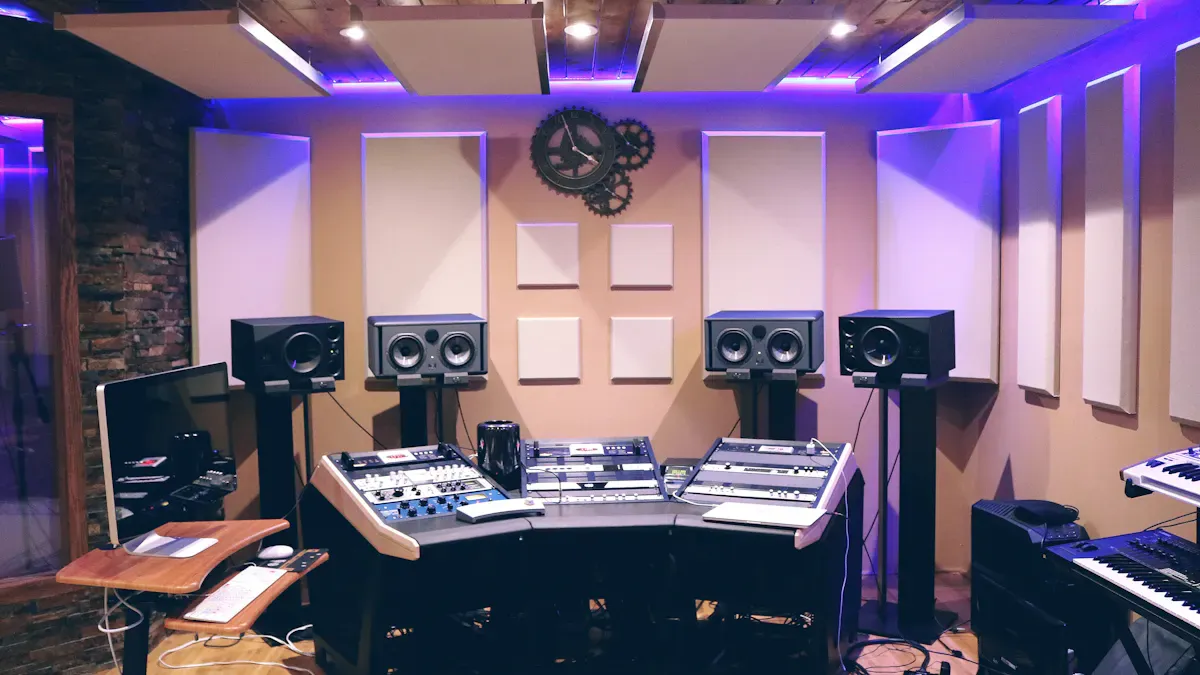
Put your speakers and seat in a triangle shape. This helps you hear music evenly from both sides.
Use thick panels on the first spots where sound bounces off walls and ceiling. This stops early reflections that can make music and speech unclear.
Put deep bass traps in all corners and where walls meet the ceiling. Bass traps soak up low sounds and stop bass from being too loud.
Add panels or diffusers to the back wall behind your seat. This controls reflections and makes the room feel bigger.
Hang ceiling panels above your seat and between the speakers. These panels absorb sound from the ceiling and make things clearer.
Place diffusers on the back wall, side walls farther from your seat, and ceiling. Diffusers spread sound around and keep the room lively.
Use both absorption and diffusion. Too much absorption makes the room sound dull. Too little makes it echo.
Test your room after setting up your speakers and panels. Listen and use tools to adjust for the best sound.
Tip: If your room has lots of hard surfaces, try speakers that send sound in a narrow direction. This helps cut down on unwanted reflections.
Acoustic Treatment Solutions
You can control sound reflections with panels, bass traps, and diffusers. Each tool works in its own way:
Acoustic panels soak up sound waves when they hit. The inside material turns sound into heat, lowering reflections. Pick panels with a high NRC for better absorption.
Bass traps catch low sounds that build up in corners. They help balance the bass and keep it from being too strong.
Diffusers spread sound waves in many directions. This breaks up echoes and keeps the room from sounding too flat or too lively.
Acoustic panels are important because they absorb sound waves. They help make the sound clearer and easier to hear.
Professional studios use both absorbing and spreading materials to control reflections. They focus on early reflections, especially those that come within 15 milliseconds, to keep music clear. You can do this at home or work to get better sound.
Take care of your panels and traps. Dust or vacuum them often so they keep working well. Check for damage and replace panels if needed to keep your sound balanced.
Using Rugs, Curtains, and Furniture
You can use things you already have to control reflections and make your speakers sound better. Rugs, curtains, and furniture all help manage sound:
Rugs soak up mid and high sounds, making sharp noises softer and cutting down echo.
Curtains block both inside reflections and outside noise, making your room quieter.
Sofas, bookshelves, and other furniture break up sound waves and stop them from bouncing straight back.
Note: Using these items together makes your room more controlled. They stop sound waves from bouncing off hard surfaces.
If you want to save money, try fabric panels, foam, or thick curtains. You can make your own panels for a personal touch. For bass, buy floor or ceiling bass traps and put them in the corners.
Balancing Absorptive and Reflective Surfaces
You need to use both absorbing and reflecting surfaces to get natural sound. Absorbing things like panels and rugs cut down echoes and make sound more focused. Reflecting things like wood or glass keep the room lively. Diffusers add space without making harsh echoes.
Absorption near speakers makes the sound stage smaller and more focused.
Diffusers on the back wall or ceiling make the sound bigger and more immersive.
Spread-out reflections do not mess up stereo sound and help reduce color changes.
The right mix depends on your room and what you want. Try different setups to see what works best.
Advanced Tools and Design Strategies
You can use special software to see how sound moves in your room. DSP technology lets you change speaker output to fix room problems. Advanced speaker designs with better drivers and coils can lower distortion from reflections.
ZEH Audio uses these tools and designs to help you get the best sound. Their skills in speaker and room design make sure you get clear, accurate sound at home or work.
Fine-Tuning for Different Rooms
Small vs. Large Spaces
Small and large rooms have different sound problems. Each room needs its own plan to get good sound.
Small rooms have quick reflections. These can make some sounds cancel each other out. You might hear boxy sounds or too much bass. Sometimes, certain notes sound louder. Sound does not stay inside well.
Large rooms need help spreading sound everywhere. Absorption does not always fix things. You must make sure everyone hears the same sound.
Aspect | Small Rooms | Large Rooms |
|---|---|---|
Acoustic Challenges | Bass gets too strong, notes can ring, sound leaks | Sound is uneven, reflections are hard to fix |
Treatment Focus | Use bass traps, thick panels, treat first spots | Use diffusers, thin panels, check sound coverage |
Absorption Profile | Put panels at first bounce spots | Spread thin panels all over the room |
Diffusion Usage | Use diffusers only on back walls | Use diffusers everywhere, part of room design |
Design Approach | Make one end quiet, focus on best seat | Use ray tracing, make sound even for all |
In small rooms, use thick bass traps and panels. Put them where sound bounces first and in corners. In big rooms, use diffusers and thin panels. Spread them out across the room. Use tools to check if sound covers the whole space. ZEH Audio makes special plans for both room types using smart design.
Adapting to Listening Preferences
How you set up your room depends on what you like. Some people want a wide soundstage. Others like strong bass or clear voices. You can change your setup to fit your taste.
Hang curtains behind your seat to stop reflections.
Put panels on walls to make sound clearer.
Use a thick rug with a pad to soak up floor sound.
Pick soft furniture, like a cloth ottoman, to break up sound.
Move your speakers and seat to find the best spot.
How you hear soundstage, bass, and clarity depends on your room. If you want a wide soundstage, control side wall reflections. For more bass, add traps in corners. For clear sound, use more panels at first bounce spots. ZEH Audio helps you pick what works best for your room and your needs.
Tip: Try different setups and listen to what sounds best. Every room and person is different.
You can make your speakers sound better by controlling sound reflections. First, put your speakers at ear height. Turn them so they face where you sit. Put acoustic panels and bass traps on the walls and ceiling where sound bounces first. Use isolation platforms for parts that shake easily. These steps help you hear music more clearly and make left and right sounds easier to tell apart.
Quick Checklist:
Find and fix reflection points
Set up speakers the right way
Add acoustic panels and bass traps
Keep audio parts steady
Try these ideas to see what works best. ZEH Audio has special ways to help you get great sound in any room.
FAQ
What are the most important reflection points to treat in a room?
You need to treat the first spots where sound bounces. These are on the side walls, ceiling, and floor. These places cause early reflections that make sound less clear. Put acoustic panels or diffusers there for better sound.
How does speaker placement affect sound reflections?
Where you put your speakers changes how sound hits things. You can lower bad reflections by making a triangle with your speakers and seat. This setup helps you hear music clearly and makes stereo sound better.
Can furniture and décor improve room acoustics?
Yes. Rugs, curtains, and bookshelves soak up or spread out sound. You can use them to cut down on echoes and control reflections. They are an easy way to make sound better without special gear.
Why does ZEH Audio focus on controlling early reflections?
ZEH Audio controls early reflections to give you clear sound. Early reflections change how much detail and space you hear. By managing these, you get balanced and immersive sound.