
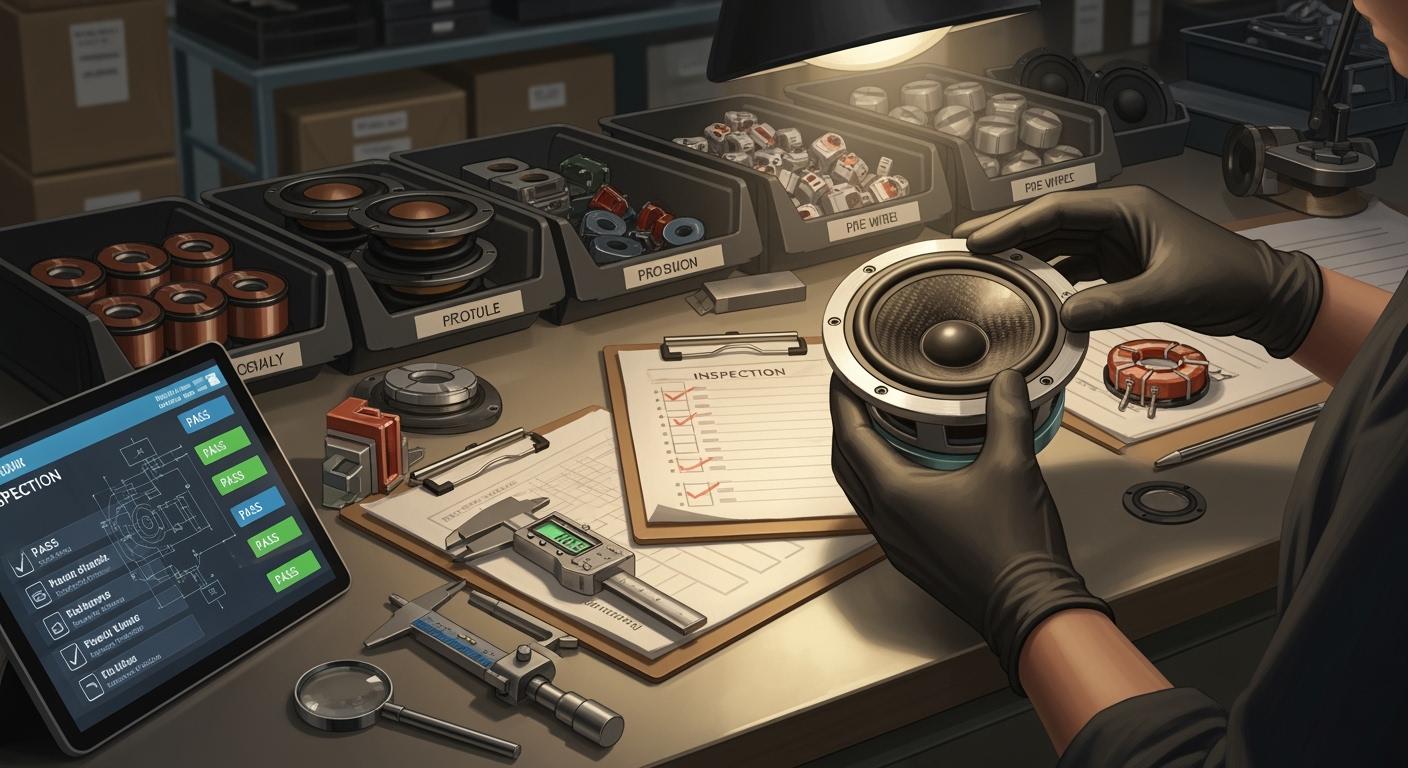
You want speakers that always give clear and steady sound. Speaker makers use quality control at every step in mass production.
They pick strong materials, like composite diaphragms and voice-coil assemblies, to keep sound good.
Special machines and trained workers check that each speaker meets tough rules.
Careful supply chain plans stop shortages and keep making speakers smooth.
These steps help you get speakers that sound good and last a long time.
Key Takeaways
Quality control begins with good materials. Pick strong parts to make sure the sound is clear and the speakers last long.
Training helps build a quality mindset. Give your team the skills to spot and fix problems. This makes the product better.
Test carefully at every step of making speakers. Use end-of-line testing to find problems before shipping.
Follow industry rules and certifications. Meeting standards like ISO9001 helps customers trust your product and feel happy.
Always try to get better. Check your work often to lower mistakes and make speakers work well.
Company-wide quality commitment
Quality culture and training
You help make a strong quality culture. Speaker companies teach you how to find and fix problems. When you learn about quality management, you help stop mistakes. Training gives you skills to check each speaker. You make sure it is good enough. This focus on quality helps you do better work every day. You see how your work changes the final product and makes customers happy.
Tip: If your team cares about quality, you feel proud. You also help your team do their best.
Speaker makers use different ways to keep quality high. Here is a table that shows common company-wide quality commitment practices:
Quality Commitment Practice | Description |
|---|---|
Lean Manufacturing | You use Kanban, PokaYoke, Kaizen, and 6S to make work smooth and cut waste. |
Continuous Improvement | You always try to make things and processes better. |
ISO9001-2015 Standards | You follow world rules to keep product quality high. |
Rigorous Quality Control Measures | You test each speaker to meet tough rules before shipping. |
These ways help you make speakers that people trust.
Certifications and standards
You must follow important certifications and standards to show your speakers are safe and work well. Many speaker companies get these certifications:
CE
RoHS
FCC
These rules show your speakers are safe and good for the environment. When you follow them, customers trust you more and see you care about quality.
Customer happiness depends on your company’s quality plans. Good products, helpful service, and easy tools make customers happy. Here is a table that shows how these things help customer satisfaction:
Aspect | Impact on Customer Satisfaction |
|---|---|
High Quality Products | Customers like clear sound and easy use. Good packaging is important too. |
Customer Service | Fast answers and help make customers feel important. |
Self-Service | Online tools let customers fix problems by themselves, which makes them happier. |
You can see that quality control and company-wide care help you give people speakers they love.
Quality assurance in loudspeaker production
Design and engineering controls
You help make sure each loudspeaker is made well. You use design and engineering controls to stop problems before they start. You do tests at the end of the line to find issues before speakers go to customers. You check frequency response by testing the speaker from many sides. This shows if the sound stays clear when used in real life. You also measure total harmonic distortion. This test helps you find extra noise or mechanical problems. Impedance testing shows how well the speaker works with an amplifier. These tests help you keep quality high and make sure every loudspeaker sounds good.
End-of-line testing finds problems before shipping.
Frequency response testing checks sound from all sides.
Total harmonic distortion testing finds extra noise.
Impedance testing checks power use and build strength.
Supplier and material management
You need good supplier and material management to keep quality steady. You pick suppliers from different places to avoid trouble if one area has problems. You check new suppliers to make sure they meet your standards. You use materials that last long and follow safety rules. You also use new technology, like AI-driven inspection, to find problems early. These steps help you keep making speakers and make sure each one meets your quality goals.
Pick suppliers from many places to avoid delays.
Test new suppliers to keep quality steady.
Use safe, strong materials for longer life.
Use AI tools to find problems fast.
Process monitoring
You watch every step in making speakers to keep quality high. You start by making pre-production samples for customers to check. This lets you fix problems before making lots of speakers. You follow ISO 9001:2015 standards, so you check quality at every step. You use these steps to make sure each speaker is what customers want.
Evidence Description | Key Practices |
|---|---|
Pre-production samples are given to customers before mass production. | This lets you make changes before making many speakers, so the final product matches what customers want. |
You follow ISO 9001:2015 standards in making speakers. | This means you check quality at every step to keep standards high. |
You use these ways to keep quality high and give people speakers that work well every time.
Quality control inspection methods
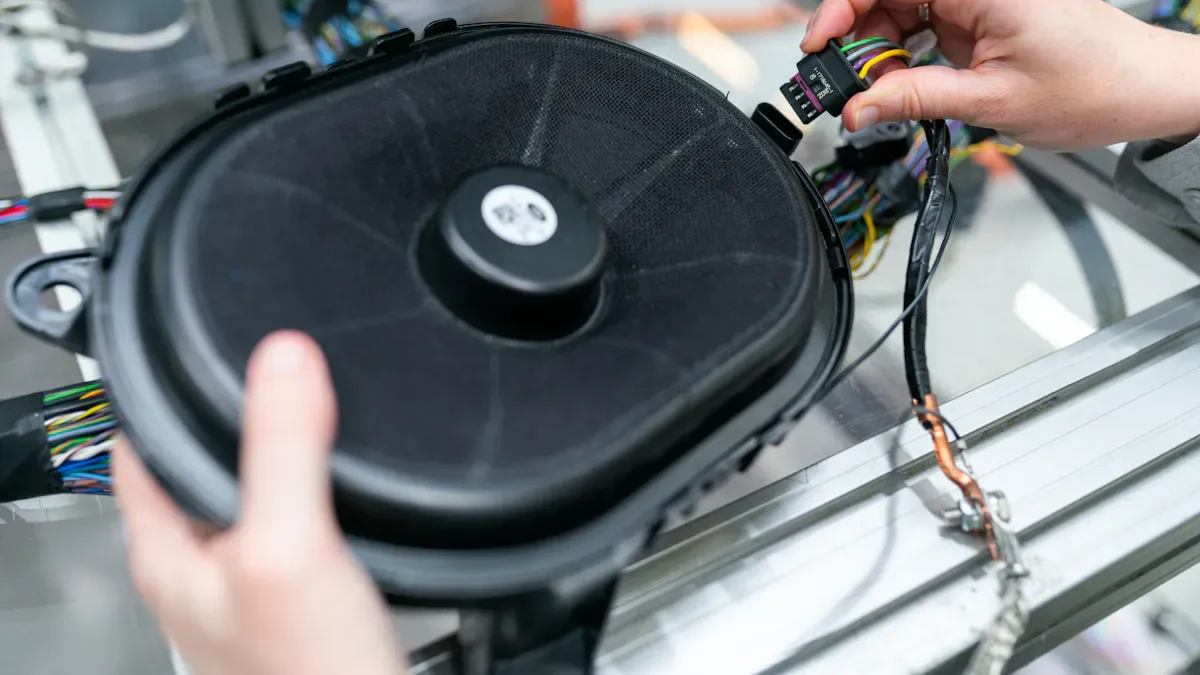
You need strong quality control inspection methods to make sure every speaker works well. You check speakers at every stage, from the start of production to the final shipment. This helps you catch problems early and deliver consistent quality.
Pre-Production inspection
You start by checking all parts and materials before they go into the factory. You test for things like RoHS compliance, magnetic field strength, and humidity resistance. These checks stop bad parts from getting to the assembly line. You set clear rules for what is okay and what is not. You use AQL to decide how many defects are allowed in a batch. This helps you and your suppliers agree on quality.
Here is a table that shows how you use AQL in pre-production inspection:
Key Point | Explanation |
|---|---|
AQL defines the maximum acceptable defect rate for a batch. | This establishes a clear threshold for quality control in manufacturing. |
It sets expectations between buyers and suppliers. | This ensures both parties are aligned on quality standards. |
It balances inspection costs with acceptable risk. | This helps manufacturers optimize resources while maintaining quality. |
You use incoming quality control to find fake parts and materials that do not meet your needs. Only good parts are used to make your speakers.
In-Process inspection
You use in-process quality control to watch every step as you build speakers. You write down important details, like how well soldering is done and the order of assembly. You check for mistakes while making each speaker. This helps you fix problems before they get worse.
You use sweep tests and multi-tone tests to check for distortion. You measure sensitivity by seeing how loud the speaker gets with one watt of power at one meter. You also check the frequency response curve to see if the speaker plays all sounds clearly. You use klippel qc systems to measure these things quickly and accurately.
Here is a table that shows the main stages of quality control inspection in speaker mass production:
QC Stage | Description |
|---|---|
Incoming Quality Control (IQC) | Verification of components for compliance with supplier standards and extensive testing before entering production. |
In-process Quality Control (IPQC) | Continuous monitoring and analysis of critical parameters during production to prevent non-compliance. |
Finished Product Quality Control (FPQC) | Comprehensive inspections and testing of finished products to ensure they meet quality standards and specifications. |
You use in-process quality control to stop solder problems and assembly mistakes. You keep quality high by checking every step.
Pre-Shipment and end-of-line testing
You finish by testing every loudspeaker before it leaves the factory. You use end-of-line testing to make sure each speaker meets your standards. You run tests for frequency response, total harmonic distortion, and sensitivity. You use klippel qc and other automated systems to do these tests fast and accurately.
You use end-of-line testing to find problems like rub-and-buzz sounds or cosmetic defects. You also use quantitative testing to check many things at once. This helps you make sure every speaker sounds good and looks good.
Here is a table that shows how you use end-of-line testing and other methods to check speakers:
Testing Methodology | Description |
|---|---|
End-of-Line Testing | Ensures that each loudspeaker meets quality standards before shipping, verifying consistent performance across all units. |
Rub-and-Buzz Test | A minimal performance check that identifies audible defects but does not guarantee overall performance consistency. |
Quantitative Testing | Involves multiple parameters (e.g., Frequency Response, Total Harmonic Distortion) to ensure high-quality output across production batches. |
You use automated inspection systems to make end-of-line testing faster. These systems use sensors and AI to check every speaker. They help you avoid mistakes and keep testing quick. You save money by wasting less and having fewer recalls.
You use production line testing to make sure every speaker is ready for customers. You load and unload containers carefully so speakers do not get damaged during shipping. You use finished product quality control to check for problems and make sure speakers look good.
Note: Automated inspection systems help you keep quality steady. They make sure every speaker meets your standards before it ships.
You use these quality control inspection methods to give people great speakers every time.
Fault analysis and corrective action
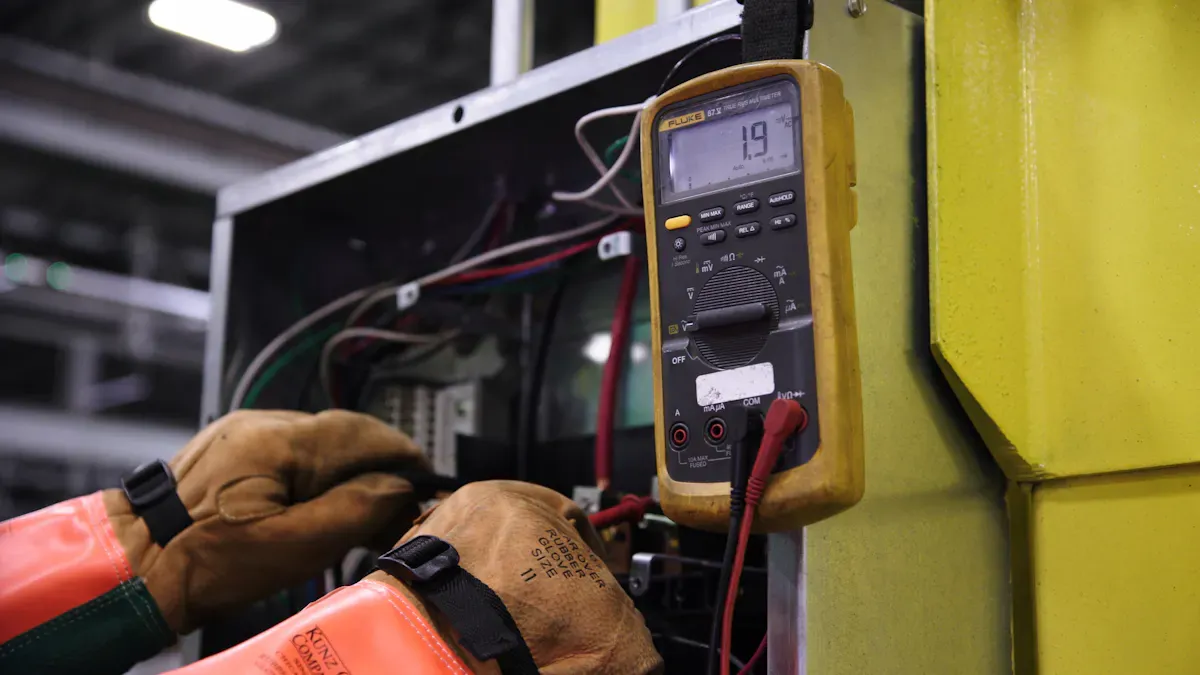
When you find a problem in making speakers, you need to figure out what went wrong and fix it. You look for the main reason so the same problem does not happen again. This helps you keep quality high and avoid big mistakes.
Root cause analysis
You use different ways to find out why a speaker does not work. You can ask “why” many times to learn more about the problem. You can make a fishbone diagram to see all the reasons for the fault. Change analysis lets you look at what was different before and after the problem. Causal factor analysis helps you write down what actions caused the issue.
Method | Description |
|---|---|
5 Whys | You ask “why” over and over until you find the main reason. |
Fishbone diagram | You make a chart to show all possible causes of the problem. |
Change analysis | You look at what changed before and after the problem happened. |
Causal factor analysis | You write down what actions or things led to the fault. |
You often see problems like noise, low sound, or no sound at all. You check for rusty pole pieces, dust in the magnetic gap, or air leaks. You also look for broken voice coils or bad welding. You use a table to keep track of these problems and their reasons.
Fault Type | Reason for Fault | Preventive Actions |
|---|---|---|
Noise | Rusty pole piece, dust, air leaks | Clean parts, vacuum dust, use enough glue, check for sharp edges. |
Low Volume | Broken voice coil | Use good coils, put them in the right place. |
Intermittent/No Sound | Bad coil, coil burns out | Use strong wire, weld well, keep power safe. |
Tip: When you find the main reason, you can fix the problem for good.
Preventive measures
You take steps to stop problems from coming back. You test speakers with sounds and signals to check all parts. You clean and check equipment often. You plan inspections to look for damage. You keep equipment in safe places and make sure it is clean.
Preventive Measure | Description |
|---|---|
Systematic Testing | You check all parts with test sounds and signals. |
Regular Maintenance | You clean and check equipment many times. |
Proactive Maintenance | You inspect and clean to stop breakdowns. |
Regular Inspections | You plan checks for damage or wear. |
Proper Equipment Care | You store and clean equipment to stop problems. |
You follow two main steps to fix problems. First, you find out what caused the problem. Then, you do something to stop it from happening again.
Phase | Description |
|---|---|
Diagnosis | You look for the main reason for the problem. |
Solution | You take steps to make sure it does not happen again. |
You use these steps to keep making speakers without trouble and keep customers happy.
Ensuring reliable speakers
Consistency and reliability
You want every loudspeaker to work well each time. You use clear ways to check if they are always the same. These checks help you find problems early. This keeps your speakers good. The table below shows some important checks:
Metric | Description |
|---|---|
On-time delivery | Checks if shipments come on time so work is not late. |
Shipment accuracy | Makes sure the right amount and type of parts arrive. |
Shows how many parts get rejected for not being good enough. | |
Responsiveness to corrective actions | Checks if suppliers fix problems fast and well. |
Torque tests | Makes sure screws and rivets are tight enough. |
Glue weight validation | Checks if the right amount of glue is used. |
Solder joint inspections | Makes sure soldering is done right and has no mistakes. |
Frequency response | Finds any strange changes in sound. |
Total harmonic distortion (THD) | Checks for extra sounds that should not be there. |
Finds problems with wires, stiffness, or other speaker parts. | |
Average sensitivity | Checks if the speaker is too quiet and needs more power. |
Resonant frequency | Makes sure the sound stays balanced and smooth. |
Polarity | Checks if the wires are connected the right way. |
You use these checks to make sure each speaker is good. Big brands like Yamaha and T.I Audio are known for strong speakers. They have clear sound and good help after you buy. They use special tests and training to keep their speakers working well.
Continuous improvement
You keep your speakers good by always trying to do better. You use programs to find and fix problems in how you make speakers. These programs use facts and teamwork to help you improve.
You use Six Sigma and Lean to make fewer mistakes and better speakers.
Everyone helps, from bosses to workers, to find new ways to improve.
You look at test results to see what needs to change.
Here is how you get better with continuous improvement:
You stop problems and fix weak spots in your work.
You make more good speakers and have fewer mistakes.
You keep checking and changing your ways to make customers happy.
Continuous improvement helps your speakers stay the best. By doing these things, you make sure your speakers are always good and meet high standards.
You get good speakers when you check quality at every step. You look at each part and test the sound. You also tune the speaker to make it work well. This helps the speaker sound clear and last longer. Your company saves money by watching the process all the time. Automation helps your company work faster.
Benefit | Description |
|---|---|
Cost Savings | You find problems early and throw away less. |
Increased Efficiency | You use information to make speakers better. |
Better Reporting | You use reports to see and fix your work. |
You and your customers get better speakers and more for your money.
FAQ
What is the most important test for speaker quality?
You should focus on the frequency response test. This test shows if your speaker plays all sounds clearly. It helps you find problems with highs, mids, and lows.
How do you spot a faulty speaker during production?
You can use automated systems to check for rub-and-buzz sounds. You also look for broken parts or poor soldering. These checks help you catch problems early.
Why do you use AQL in speaker inspection?
AQL helps you set clear rules for how many defects you allow. You use it to agree with suppliers on quality. It keeps your speaker batches consistent.
What does end-of-line testing check?
End-of-line testing checks if your speaker meets all standards before shipping. You test for sound quality, appearance, and performance. This step ensures customers get reliable products.
How do you keep speakers from getting damaged during shipping?
You use strong packaging and careful loading. You check each box for damage before it leaves the factory. This keeps your speakers safe until they reach customers.