
You can find voice assistants almost everywhere now, in homes and offices. The market for voice assistant apps is about $5 billion and grows by over 20% every year. In the United States, more people use these devices each year. As demand increases, the hardware requirements for speakers change significantly. Companies are focused on improving sound quality, making speakers smaller, adding smarter features, and using less energy to meet your needs.
Key Takeaways
Voice assistant speakers are changing to meet new needs. People want better sound, smarter features, and less energy use. MEMS microphones and new codecs like LDAC make sound clearer. These help speakers work well even when it is loud. Making parts smaller lets companies build small speakers. These small speakers can still play strong sound and keep good quality. Using less energy helps lower power use. This saves you money and is good for the Earth. Smart features like voice control are now common. Home automation makes these speakers important for everyday life.
Evolving Hardware Requirements
The voice assistant market is growing fast. This makes companies change how they build speaker hardware. People want better sound, smarter features, smaller size, and less power use. These new needs change how speakers look and work today.
Sound Quality Upgrades
People want smart speakers to sound clear and full. MEMS microphones help the device hear you well. They work even if the room is loud. AI technology needs good audio, so companies make better speaker drivers and codecs. LDAC codec lets you listen to music almost like a CD over Bluetooth. It also lowers delays and works with different bitrates. This makes music smoother. These upgrades help your voice assistant answer faster and play better music.
MEMS microphones pick up sound clearly.
LDAC codec gives high-quality sound over Bluetooth.
AI needs good audio input for better results.
Smart Feature Integration
Speakers now do more than just play music. You can control smart home devices and connect with Wi-Fi or Bluetooth. You use your voice for hands-free tasks. Companies add things like natural language processing and machine learning. These help your device understand you and talk back in a normal way. You can organize your home, set reminders, and ask about the weather. Smart features make your speaker important in your daily life.
Feature | Description |
|---|---|
Smart Home Control | Control smart devices for better organization and efficiency. |
Bluetooth and Wi-Fi | Connect to other devices for seamless integration. |
Voice Command | Use your voice for hands-free convenience. |
AI natural language processing helps the speaker understand speech.
Machine learning lets the speaker do harder tasks and answer better.
Miniaturization Trends
People want speakers that fit anywhere, like on a desk or counter. Micro-speaker technology helps make small speakers without losing sound quality. Multi-directional speakers give you great sound in a small size. Using green materials and saving energy helps the planet. Special algorithms for noise cancellation and spatial audio make speakers work well in small spaces.
Miniaturization means you get strong sound from small speakers.
Micro-speaker technology makes small speakers possible.
Multi-directional speakers give you surround sound.
Green materials and energy-saving designs help the environment.
Energy Efficiency
People care about how much energy their speakers use. Companies try to make speakers that save energy and are good for the planet. Using less power means your speaker lasts longer and costs less to use. You help the earth by picking devices that use less energy.
Energy-saving speakers use less power and help the planet.
Speaker hardware keeps changing as the market grows and people want more. You get better sound, smarter features, smaller size, and more efficient speakers.
Technical Advances in Speaker Hardware
Today’s voice assistant speakers use new technology to help you. You want your speaker to hear you well and answer fast. You also want it to sound good. Companies work to make every part better. Here are the main ways smart speakers have improved.
Microphone Arrays
Microphone arrays help your speaker hear you from far away. These arrays use many microphones together. This helps the speaker hear your voice even with noise or music. Many smart speakers use digital MEMS microphones. These are small and very sensitive. Some devices, like the Josh Nano, use four microphones for far-field listening. They also have privacy switches to keep you safe.
Here is a table that shows what a modern microphone array system can do:
Feature | Specification |
|---|---|
Core Processing | Embidio Hub (XMOS) + Raspberry Pi Compute Module |
Microphone Array | Integrated 8 digital MEMS |
Speaker | Integrated 2 x 4 W Stereo |
Connectivity | Ethernet, Wi-Fi/Bluetooth (via RPi), USB |
Audio Processing | Beamforming, Noise Reduction, Acoustic Echo Cancellation, AGC, EQ, etc. |
Input Channels | 8 |
Output Channels | 2 (Stereo) |
Sampling Rates | 16 / 48 kHz |
OS | Linux (on Raspberry Pi) |
These arrays use special processing to block out noise. They focus on your voice. Some systems use beamforming. This means the microphones work together to find where your voice comes from. This makes voice commands work better.
Audio Processing Power
Your voice assistant needs strong audio power to work well. Modern speakers use special chips and sometimes GPUs with lots of memory. Some systems have 32-64GB RAM and hardware just for AI. This helps the speaker do hard jobs, like hearing you in noisy rooms or playing great music.
Different models process audio in different ways. Here is a table that shows how they work in noisy places:
Model Type | Performance Under Noise | Resilience to Variations |
|---|---|---|
Naive Pipeline | Higher | High |
VITA | Lower | Low |
Whisper Speech Encoders | Similar Levels | High |
End-to-End Models | Lower | Susceptible |
Speakers with strong processors and smart software work better. They answer you faster and play clearer sound.
Far-Field Voice Recognition
Far-field voice recognition lets your speaker hear you from far away. This uses smart microphones and software to pick out your voice. It works even if there is background noise. For example, Synaptics’ AudioSmart can tell your voice from TV sounds. It can also hear you while music plays, using acoustic echo cancellation. Some systems know where your voice is coming from. This makes answers more accurate.
New advances help your speaker understand you, even in different languages. Your device can learn from what you ask and change home settings for you. This makes your speaker more helpful and personal.
Tip: Far-field voice recognition means you do not need to yell or stand close. Your speaker hears you from anywhere in the room.
Balancing Bass and Clarity
You want your speaker to sound good for music and voice. This is hard because strong bass can make voices less clear. Companies use different ways to fix this:
Center channels make voices clearer by separating speech from music.
Dialogue processing software boosts speech with special algorithms.
Audio presets like ‘Dialogue’ or ‘Clear’ mode help you hear voices better.
You can change bass and treble settings yourself to fit your needs.
These ideas help your speaker give you deep bass for music and clear voices for commands. You get both at the same time.
Note: You can find audio presets in your speaker’s app. Try different modes to see which one you like best.
Modern voice assistant speakers have many challenges. They must balance sound, smart features, and energy use. Companies meet these needs with better microphones, strong processors, and smart audio software. As the market grows, your smart speakers will keep getting better.
Key Design Challenges
Size vs. Sound Quality
People want speakers that fit anywhere and sound great. This is hard for engineers to solve. Small speakers cannot move much air, so bass is weaker. Designers must put drivers in the right spots for good sound. The fabric on the speaker needs to let sound out but stay strong. It should not make extra noise. Smart speakers use special algorithms to change sound for each room. This helps you hear music well wherever you put the speaker.
Small speakers have less bass because of less air movement.
Engineers place drivers carefully for better sound.
Speaker fabrics must be strong and let sound pass.
Algorithms change sound to fit different rooms.
Power vs. Performance
You want your voice assistant to always listen and answer fast. This means the speaker uses power all the time. To save energy, designers use hardware that does not waste power. Voice Activity Detection (VAD) helps the speaker use less energy when no one talks. Some speakers have edge audio processors that work quickly and use little power. These choices help your speaker work well and not waste energy.
Always-on listening uses more power.
Power-saving designs lower energy use.
VAD saves energy when the speaker is idle.
Edge processors help balance speed and power.
Device Compatibility
You want your speaker to work with many devices and apps. Sometimes, sounds from TVs or other things make it hard for your speaker to hear you. Some speakers need to send audio to a server to check for wake words. This can make the speaker slower and harder to connect with other devices. Engineers try to stop interference and make connections better.
Other sounds can make it hard for the speaker to hear commands.
Some speakers need servers for extra processing.
Compatibility problems can slow down the speaker.
Durability
You want your speaker to last a long time. Designers use strong materials like aluminum, porcelain, and brass to make speakers tough. Some smart speakers have ceramic shells you can fix using old methods. This makes them strong and nice to look at. Modular designs let you take parts off for repairs or upgrades. Many speakers have QR codes or stickers to help track and recycle them. These things help your speaker last longer and be worth more.
Aluminum and brass make speakers strong and easy to recycle.
Modular parts make repairs and upgrades simple.
QR codes and take-back programs help with recycling.
Good materials and design make speakers special.
Tip: Picking a strong speaker helps the earth and lets you use it for many years.
Custom Solutions for Voice Assistant Speakers
ZEH Audio Innovations
You want your voice assistant speaker to work well everywhere. ZEH Audio makes custom solutions for different needs. Their team builds microphone arrays that help your device hear you, even with noise in the room. They also design the inside and outside of the speaker to keep microphones away from loud parts. ZEH Audio uses special chips for wake word detection and command processing. This setup keeps your privacy safe and helps your speaker answer faster.
Microphone arrays help your speaker hear you better.
Acoustic design changes how your speaker sounds.
Special processors handle commands quickly and safely.
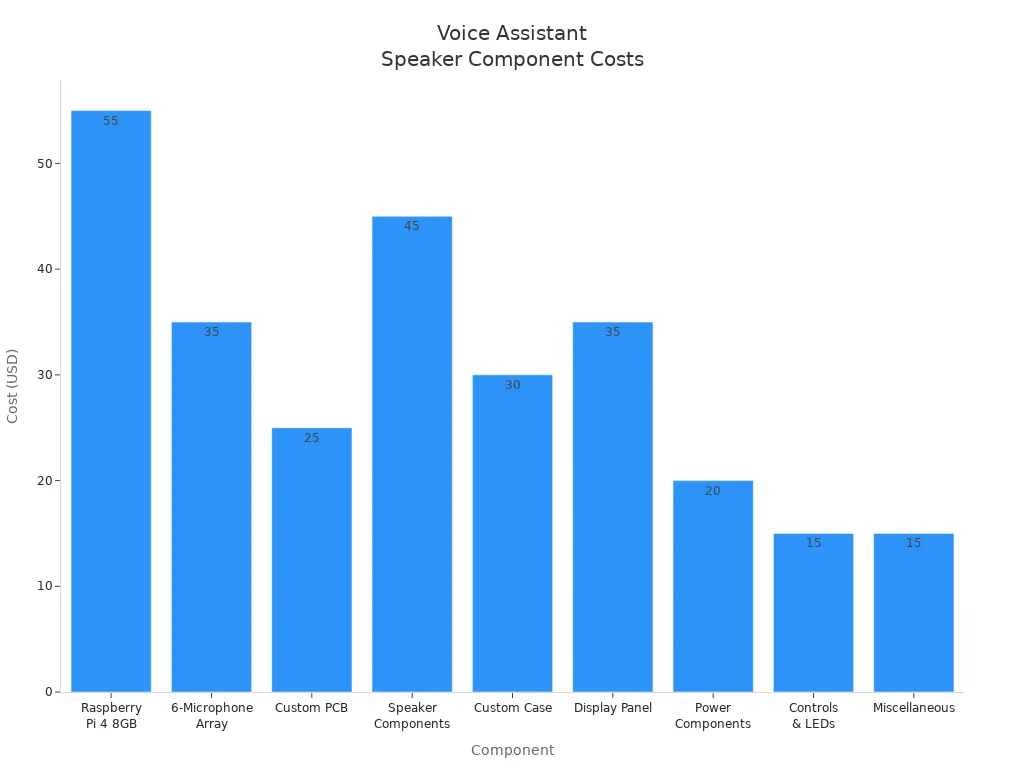
Here is how custom hardware solutions are used in a project:
Component | Description | Cost |
|---|---|---|
Raspberry Pi 4 8GB | Main processing unit | $55 |
6-Microphone Array | High-quality voice pickup | $35 |
Custom PCB | Audio & power management | $25 |
Speaker Components | Mid-range + tweeter system | $45 |
Custom Case | 3D printed + laser cut acrylic | $30 |
Display Panel | Optional visual feedback | $35 |
Power Components | Supply & management | $20 |
Controls & LEDs | Buttons, LEDs, interconnects | $15 |
Miscellaneous | Hardware & assembly | $15 |
TOTAL | ~$275 |
Audio Optimization
ZEH Audio uses many ways to make your speaker sound better. The team makes sealed boxes to stop phase cancellation and boost bass. They use isolation gaskets to block extra noise. Class-D amplifiers use most of the power for sound, so they are efficient. Automatic gain control changes the volume based on what you hear and how loud your room is. Digital signal processing adds features like noise reduction and echo cancellation.
Technique | Description |
|---|---|
Enclosure Design | Sealed boxes improve low-end sound. |
Placement and Isolation | Stops unwanted vibrations and noise. |
Thermal Management | Keeps your speaker cool and lasting longer. |
Class-D Amplifiers | Use power efficiently for better sound. |
Automatic Gain Control | Changes volume for clear speech and music. |
Digital Signal Processing | Adds smart audio features for better listening. |
Smart Control Integration
You want your speaker to do more than play music. ZEH Audio makes small speakers that fit into many smart home devices. Your speaker can give voice reminders for smart door locks, play feedback sounds for control panels, and show status for smart curtain motors. These features help your speaker fit into your daily life and make your home smarter.
Small speakers fit in many devices.
Audio feedback helps with smart home actions.
Voice reminders and status sounds keep you updated.
ZEH Audio meets today’s hardware needs by focusing on sound quality, smart features, and saving energy. You get a speaker that fits your space and works for you.
Speaker hardware for voice assistants is changing a lot. Companies want to make sound better and add smart features. They also try to make speakers smaller and save energy. These new ideas change what people want from smart speakers:
Better privacy and security
Health and wellness tracking
Connecting to more devices
Designs that are good for the planet
“You feel safer with your voice assistant when it works well and keeps your information safe.”
Custom solutions, like ZEH Audio, give you great sound and smart features. These changes help your speaker work for you now and in the future.
FAQ
What makes sound quality important in voice assistant speakers?
You want your voice assistant to hear you and play music well. Good sound helps you listen to answers and enjoy songs. Clear audio lets the device hear your voice, even if it is noisy.
How do smart features affect speaker hardware?
Smart features like voice commands and home control need special chips and microphones. These parts help your speaker work fast. You get quick answers and more ways to use your device.
Why do companies make speakers smaller?
You want speakers that fit anywhere in your house. Making them smaller lets you put them on desks or shelves. Small speakers use new technology to keep sound strong and clear.
How do energy-efficient speakers help you?
Energy-efficient speakers use less power. You save money on your electric bill. These speakers also help the planet by making less waste. Many new models use special designs to save energy but still work well.
What is a microphone array, and why does it matter?
Feature | Benefit |
|---|---|
Multiple Mics | Picks up your voice better |
Noise Blocking | Ignores background sounds |
Far-Field Use | Hears you from across the room |
Microphone arrays help your speaker hear you well, even if you are far away or the room is loud.