
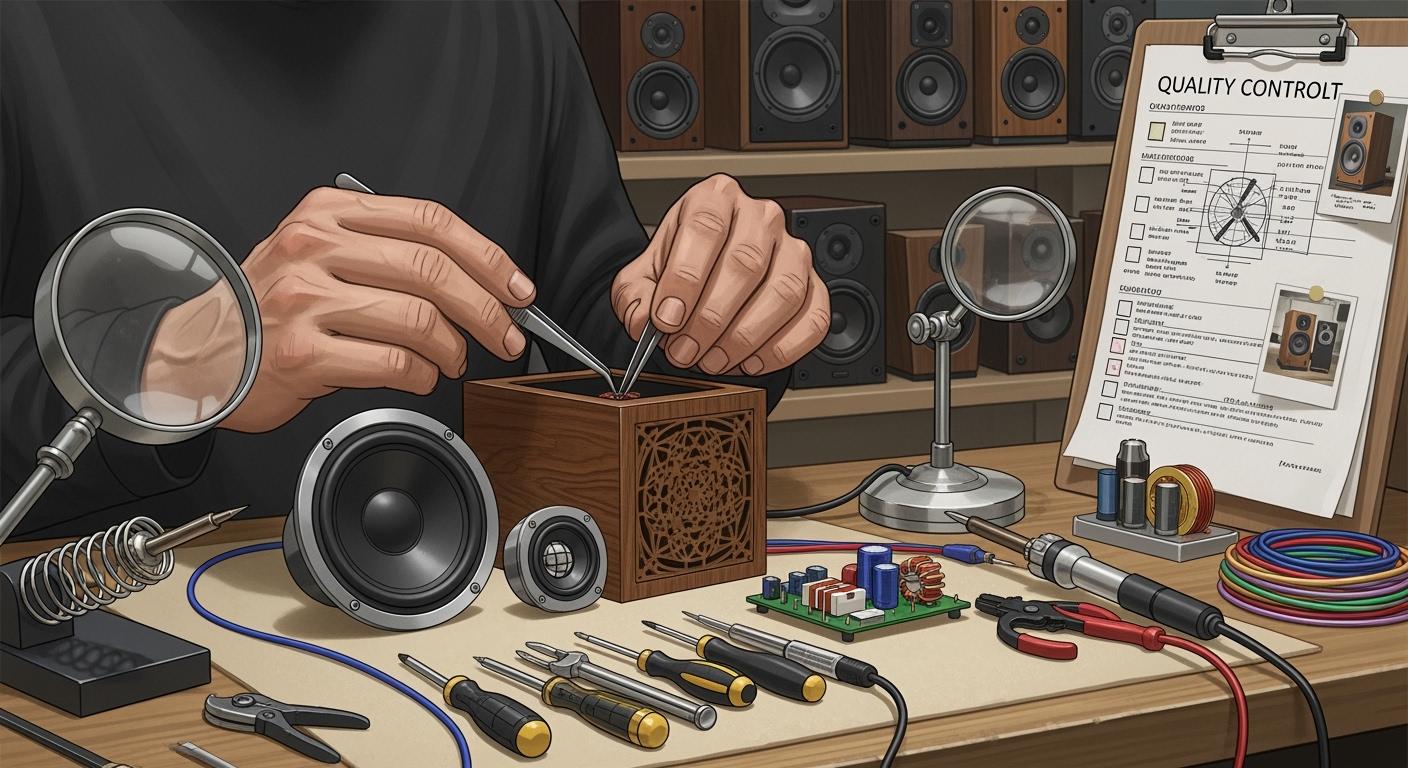
You can maintain the consistency of craftsmanship in speaker customization by implementing strict quality checks, utilizing advanced modeling software, and managing processes carefully. The consistency of craftsmanship is crucial because it influences the performance of speakers, their reliability, and overall customer satisfaction. Many companies face challenges such as managing variations from each custom order, ensuring high quality for unique setups, and sourcing special materials. For instance, leading brands employ digital twin systems and simulation tools to monitor and adjust every detail. This approach helps meet performance standards and reduces costly returns.
Key Takeaways
Use strict quality checks so every speaker is very good. This helps stop mistakes and makes customers happy.
Try out designs with special software before making them. This finds problems early and keeps custom orders the same.
Make clear goals for how speakers should work and look. These goals are based on what customers want. This helps your work stay focused and meet what clients expect.
Keep the place where you make speakers very clean and steady. Clean rooms and steady conditions help every speaker be high quality.
Use both machines and skilled workers to make speakers. This mix helps things go faster and keeps quality high.
Demand Analysis and Goal Setting
A good start for speaker customization needs clear demand analysis and goal setting. You must know what your clients want. Then, you turn their needs into goals you can measure. This way, you keep the consistency of craftsmanship that makes your products special.
Understanding Customer Requirements
Begin by collecting detailed information from your clients. Ask about their favorite sound, design choices, and how they plan to use the speakers. You can use surveys, interviews, or talk to them directly. Write down every need so you do not forget anything later. Good notes help you track changes and find problems if they happen.
Tip: Keep inspection records and process notes current. This helps you follow ISO 9001 rules. It also keeps you focused on customers and helps you improve all the time.
Aspect | Description |
|---|---|
Inspection Records | Written inspection records for important parts help you track and find problems. |
ISO Compliance | Following ISO 9001 rules means you must write down your steps for steady work. |
Process Documentation | Writing down each step keeps you focused on customers and helps you get better at quality management. |
Setting Performance and Quality Goals
After you know what your clients want, set clear goals for performance and quality. Top speaker makers use different ways to set and check these goals:
Make sure every speaker sounds the same.
Use design and testing tools like CAD and finite element analysis to check parts.
Control the factory for temperature, humidity, and cleanliness.
Test each speaker after it is built with electrical and sound checks, including tests in quiet rooms.
Use statistics to watch production and spot problems early.
For fancy models, tune each speaker with digital signal processing for tight limits.
By doing these things, you give your team a clear plan. You make sure every custom speaker meets the best standards.
Engineering and Material Selection
High-Quality Components
You must pick the right parts for your speakers. Good parts help your speakers work well and make customers happy. When you choose parts, follow these steps:
Pick drivers that play many sounds clearly and evenly.
Make sure the power output works for different needs and keeps sound good.
Choose batteries that last at least 10 hours, charge fast, and are strong.
Give a warranty for at least one year to show your product is trustworthy.
Tip: Always check your suppliers. Good partners help you keep quality steady and stop delays.
Advanced Simulation Techniques
You can use special software to test your designs before building them. Tools like COMSOL Multiphysics help you guess how your speakers will sound and work. This lets you control every part of the design. You can fix problems early by changing the design. Using simulation helps you keep every speaker the same, even if you make changes for different customers.
Design and Prototyping
Your engineering and manufacturing teams must talk often. They need to share news, fix problems, and stay together. Try these ways to help your teams connect:
Challenge | Solution |
|---|---|
Too much information | Focus on important messages and use simple channels. |
Teams work alone | Share knowledge between departments. |
Communication is not clear | Set rules for talking to each other. |
Use tools to help teams work together. | |
Have meetings and short talks often. | |
Show updates with pictures on screens. | |
Ask for feedback to find problems and get better. |
You can also meet in person for quick answers and better teamwork. These steps help you stop mistakes and keep your work smooth. When you use strong engineering, smart material choices, and clear talking, you build speakers that meet high standards every time.
Ensuring Consistency of Craftsmanship in Manufacturing
Controlled Production Environment
A controlled production environment helps keep the consistency of craftsmanship high. Clean rooms, steady temperature, and stable humidity stop defects. These things help every speaker turn out the same. ZEH Audio uses special controls in their factories. These controls watch air quality, dust, and climate all the time. Sensors can warn your team if something changes. This lets you fix problems before they hurt your products.
Tip: Use real-time monitoring to watch production conditions. This helps you find problems early and keep your quality steady.
When you go from making one speaker to many, new risks show up. You must buy parts carefully to avoid delays and keep quality high. Many companies have trouble moving from a working prototype to making lots of products. ZEH Audio uses strict contract manufacturing to help with this. They work hard on every step, so you do not fall into the “Valley of Death” where many products fail.
Risk Factor | Impact on Consistency |
|---|---|
Procurement Challenges | Delays and quality issues |
Prototype vs. Production Differences | Unexpected costs and defects |
Contract Manufacturing Gaps | Product failures and missed targets |
Automation and Skilled Labor
Automation is important for keeping your production steady. Machines check every step, find defects early, and make sure every speaker meets your standards. ZEH Audio uses machines for assembly, inspection, and testing. This cuts down on mistakes and keeps quality high. Skilled workers are still needed. Experts set up machines, check results, and fix problems. ZEH Audio trains their staff to use both machines and hand tools.
Here is how automation and manual work compare:
Benefit | Automation | Manual Processes |
|---|---|---|
Performance Visibility | Real-time monitoring of production | Delayed identification of issues |
Quality Inspection | Consistent, tireless inspection | Subject to human error |
Process Control | Ensures correct execution of steps | Small deviations can disrupt process |
Preventive Checks | Early detection of defects | Issues caught only at the end |
Worker Safety | Monitors compliance in real-time | Dependent on human oversight |
You can use machines to check every speaker for problems. Machines do not get tired or lose focus. Skilled workers help by solving hard problems and making things better. ZEH Audio uses both for the best results.
To see how well your factory works, track these numbers:
Metric | Description |
|---|---|
Defect rates | Counts the number of defects in products made. |
First-pass yield | Shows how many products pass checks the first time. |
Scrap and rework rates | Tells how much material is wasted or needs fixing. |
Customer complaint rates | Counts how often customers complain. |
On-time delivery performance | Shows if products are delivered on time. |
You can also use numbers like Overall Equipment Effectiveness (OEE) and First Pass Yield (FPY) to help improve quality and control.
Managing Design Tolerances
You must control design tolerances to keep every speaker working well. Tight tolerances make sure every part fits and sounds right. ZEH Audio uses special tools and strict checks to control tolerances. They follow rules for die-cut parts, reaching levels of ±0.05mm or better. This helps you avoid problems and keep your products working well.
Die-cut parts in electronics now need precision of ±0.05mm or better.
Tight tolerances help parts fit and work right in speakers.
Smaller electronics need these tight tolerances to keep sound good.
Every tiny bit matters when designing speakers, especially small ones.
Keeping everything working in small spaces is very important for new devices.
Precision is needed for modern electronics, including speakers, to work well.
ZEH Audio uses advanced measuring tools and controls to keep tolerances tight. You can use digital calipers, laser measuring tools, and automated inspection machines. These tools help you check every part and keep the consistency of craftsmanship strong.
Note: Always check your design tolerances before you start making products. This helps you avoid big mistakes and keeps your quality high.
You can keep the consistency of craftsmanship by using controlled environments, automation, skilled workers, and tight tolerances. ZEH Audio leads the way by using new technology, strong management, and strict controls. You can use these methods to keep your speaker customization reliable and high-quality.
Testing and Quality Assurance
In-Line and Burn-In Testing
You must test each speaker while making it and after. In-line testing checks speakers at different steps. This helps you find problems early. Burn-in testing means running each speaker for a long time. Usually, you run them for 48 hours in a test rack. You watch temperature and humidity to keep things steady. You check the sound at set times. If you hear changes, you stop and fix the speaker. This lowers hidden quality claims and cuts rework costs. You should test every new mold and custom order, not just a few samples. This way, you get better results than random checks.
Run every prototype and pre-production speaker for 48 hours.
Watch temperature and humidity all the time.
Check sound output at different times and mark any issues.
Test every new mold and custom order.
Statistical Process Control
Statistical process control (SPC) helps keep production steady. SPC charts let you stop problems before they start. You see how your process works right away. This helps you keep quality high and spot changes fast.
Evidence Description | Contribution to Speaker Manufacturing |
|---|---|
SPC charts help you move from reacting to stopping problems early. | Lets you find issues before they hurt product quality. |
SPC gives a visual guide to process stability in real time. | Helps you keep quality standards steady in manufacturing. |
You should use SPC to track important steps. This helps you keep craftsmanship consistent in every speaker.
Final Calibration and Auditioning
You must calibrate and audition each speaker before shipping. Good setup matters for sound quality. You need to balance room acoustics, speaker size, and position. Use room calibration software in AV receivers to measure and adjust sound. Repeat calibration and check subwoofer settings. If you find problems, fix them before sending the speaker out.
Use calibration software to adjust the room for sound.
Repeat calibration and check all settings, including subwoofers.
International standards guide your quality checks. You can follow ANSI, IEC, AES, CEA, and UL rules for testing, safety, and labeling. These rules help you meet global needs and build trust with clients.
Feedback from testing helps you get better. When you close the feedback loop, you show users you care about their input. You measure how changes help and keep improving your process.
You can keep craftsmanship consistent by following clear steps. Start with demand analysis and finish with final testing. Top companies use strict rules at every stage. This helps them make speakers that work well and last long. If you always try to get better, your speakers will sound great and stay strong. Listen to feedback and make your process better. Pay close attention to every detail. This way, both makers and users enjoy a better experience.
FAQ
How can you ensure every custom speaker meets the same quality standards?
You need to use strong process controls and watch things in real time. Machines and skilled workers help find problems early. Training your team often keeps everyone ready. Writing down steps and using feedback helps you get better with each batch.
What role does automation play in speaker customization?
Automation keeps each step the same every time. Machines do jobs like putting parts together and checking them. This means fewer mistakes and faster work. You can also see data and find patterns quickly with machines.
Why is material selection important for consistency?
Good materials help you get the same results each time. You have fewer problems and the sound stays good. Working with trusted suppliers keeps your standards high. Always test new materials before using them in your products.
How do you manage design changes without losing consistency?
Write down every change you make. Update your instructions and teach your team right away. Use version control to keep track of designs. Test new versions before making lots of them. This helps keep your quality the same.
What testing methods help you maintain craftsmanship?
You can test during building, run burn-in tests, and do final checks. These steps help you find problems early. Using statistics helps you see trends. Checking your work often and listening to customers helps you improve.