
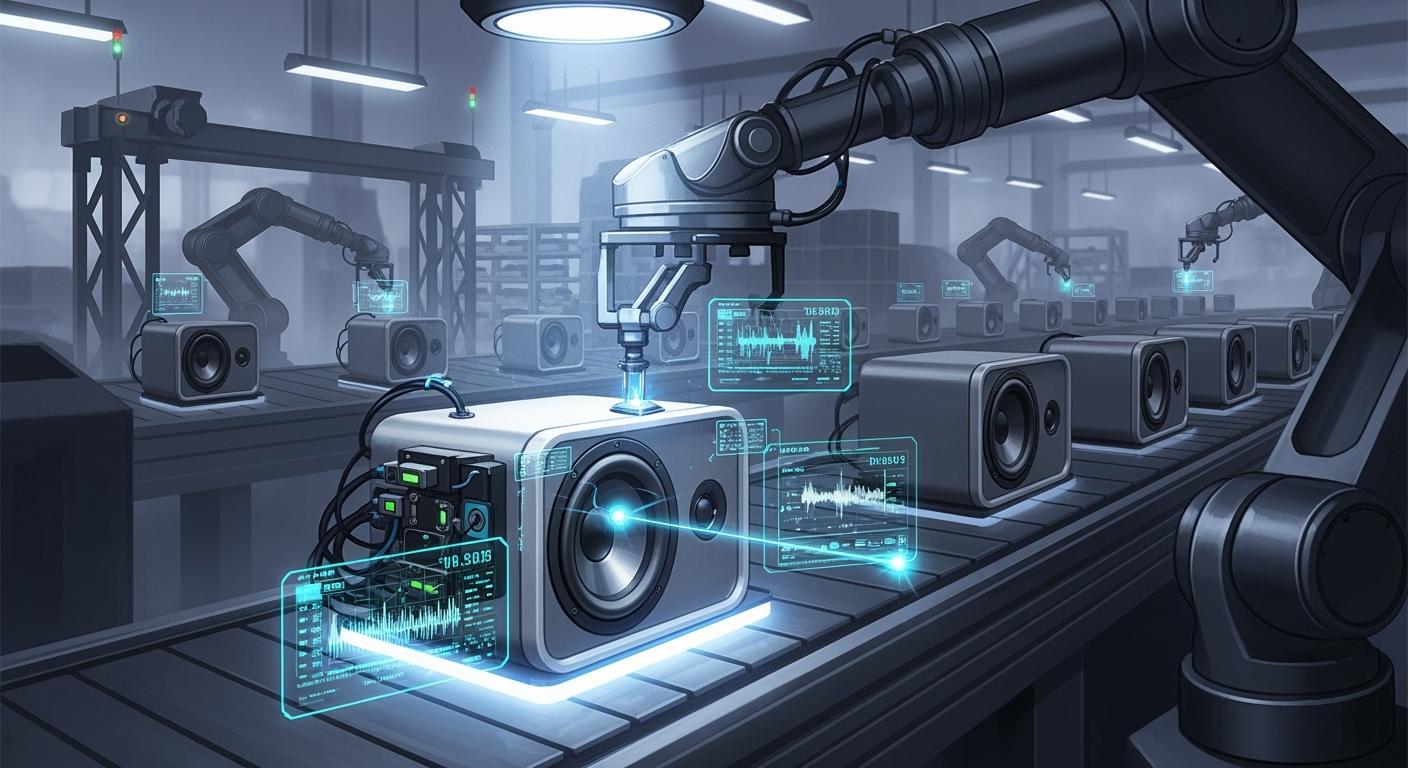
Automated Testing changes how you make speakers. You use smart machines, robots, and AI sound tests to work faster and better. These tools help you find tiny sound problems and keep your speakers good. When you use these systems, your results get better. The table below shows how these ways help you each day:
Benefit | Description |
|---|---|
Precision | Automation frameworks make audio tests very exact, so sound quality is better. |
Repeatability | Robots test the same way every time, so results do not change much. |
Comprehensive Testing | AI-powered systems can pretend to be different users, so testing is more complete. |
You get more control and feel sure about making your speakers.
Key Takeaways
Automated Testing makes speaker quality better. It uses machines and AI to find sound problems that people may not see.
Automation makes testing faster and more correct. Factories can make more speakers in less time with fewer mistakes.
When automated testing works with quality control, it finds problems early. This helps the production process go smoother.
AI-powered testing can change fast for new speaker designs. This makes it easy to keep up with changes and not slow down making speakers.
Automated testing saves money by needing less workers and making fewer errors. Teams can spend more time on new ideas.
Automated Testing Overview
Key Concepts in Speaker Production
It is important to know the main ideas about making speakers. Every speaker has different parts that must fit and work together. You need to check the sound, the materials, and how the parts move. Automated Testing uses special tools to help you do these checks. The table below shows some testing methods you might use:
Testing Method | Description |
|---|---|
SoundCheck by Listen, Inc. | Measures frequency response, phase, and distortion for quality control. |
True Technologies’ automated Life Test | Checks how speakers handle power and stress over time. |
LPM and LSI modules | Looks at linear and non-linear movement and distortion. |
Suspension Part Measurement (SPM) | Measures how the surround and spider move, which affects sound. |
Material Parameter Measurements (MPM) | Tests material strength, like Young’s Modulus, for better choices. |
Laser Scanning Vibrometer (SCN) | Shows how parts vibrate to find unwanted noises. |
You can also use things like audio fingerprinting and speech-to-text recognition. These tools help you see if your speakers work well in real life.
Automation Frameworks and Robotics
Automation frameworks and robots make testing faster and more steady. These systems can do lots of tests without getting tired or messing up. You get the same results each time, so you can trust your data. For example, companies like MISCO use smart machines to test speakers. They use tools like the Klippel scanning vibrometer and Near Field Scanner. These machines check every speaker quickly and with lots of detail. You save time because you do not have to test each speaker by hand.
Tip: Automation frameworks let you test many speakers at once, so you can make more products in less time.
AI-Powered Sound Testing
AI-powered sound testing gives you even more help. You can find small problems that people might not see. AI systems can find audio defects with 98.6% accuracy. They also make about 25% fewer mistakes than people. You do not have to spend as much time checking each speaker. About 75% of the testing can run by itself. This means you can spend more time making better speakers while the AI looks for problems.
Automated Testing helps you make better speakers, save time, and make sure every speaker sounds good.
Automated Testing Applications

Production Line Testing
You can use automated testing on your speaker production line to boost speed and accuracy. Many factories face noise challenges that hide defects. Noise-immune test systems help you find problems even in loud environments. When you move from research to production, you need systems that work fast and adapt to changes. Most factories compare each speaker to a “golden unit” to keep quality steady.
You can see these results:
A TWS earphone company doubled its output from 200 to 400 boards per hour by merging four test lines into two. Labor costs dropped by 37.5%.
A smart speaker factory used multi-channel audio testing. Defect rates fell from 1.2% to 0.5%. The factory also saved space.
Integrated testing can cut equipment costs by over 30%. You can save up to RMB 300,000 each year. Defect rates can drop by more than 40% compared to old methods.
Quality Control Integration
You can make your quality checks stronger by linking automated testing with your control systems. This helps you catch problems early and keep your process smooth. Here are some key parts:
Key Component | Description |
|---|---|
Governance Process | Set clear roles for everyone in the testing process. |
Operational Procedures | Use set steps to keep testing steady and quick. |
Automated Reporting | Get instant reports to track results and share them fast. |
You should pick which tests to automate, check your team’s skills, and choose tools that fit your needs.
Dynamic Test Generation
You can use dynamic test generation to create new test files and cases on the fly. This means you can test many speaker types and features without stopping your line. Automated Testing lets you run tests for different sounds, voices, and languages. You can find problems that only show up in special cases. This keeps your speakers ready for real-world use.
Workflow Automation
Workflow automation helps you save time and cut down on mistakes. AI-driven systems can handle tasks like scheduling, reporting, and even note-taking during meetings. You get faster results and better tracking. Many companies see a 15% rise in meeting success and better decision-making. You can focus on making great speakers while the system handles the busy work.
Tip: Use workflow automation to boost your team’s productivity and keep your speaker quality high.
Advantages of Automated Testing
Reliability and Consistency
You want your speakers to sound good every time. Automated Testing helps you do this. Machines do the tests instead of people. This removes guessing and opinions. Each test is done the same way. You can trust the results.
Machines do not get tired or lose focus.
Every test can be done again and again.
You get the same checks for every speaker, no matter the batch.
This means you can feel sure your speakers will meet high standards every time.
Detecting Inaudible Defects
Some speaker problems are too small for people to hear. Automated Testing uses special tools and AI to find these hidden issues. The system can catch tiny defects, like small shakes or noises, before they become big problems. You can fix these issues early and avoid sending bad products to your customers. This keeps your brand strong and your users happy.
Speed and Efficiency
You can test more speakers in less time with Automated Testing. Machines work much faster than people. They do not need breaks or rest. This means you can finish your testing quickly and move your products to market faster.
Automated systems test at a much higher speed than manual methods.
You get better accuracy and improved efficiency.
Faster testing helps you deliver quality speakers sooner.
You save time and keep your production line moving smoothly.
Cost and Resource Savings
Automated Testing helps you save money and resources. You need fewer workers to run tests, so you can use your team for other important jobs. You also spend less on fixing mistakes because the system catches problems early. This reduces waste and lowers your costs.
Automated Testing also makes it easy to update your tests. You can change test settings quickly without making new test plans for every speaker model. This lets you add new features or check new functions, like voice recognition, without slowing down your process. You can use common programming languages and test frameworks to make updates simple and smooth.
Note: Automated Testing also helps you control the testing environment. You can manage temperature changes and block out factory noise. This keeps your results accurate, even in a busy factory.
Manual vs. Automated Testing
Accuracy and Error Reduction
You want your speakers to work right every time. Manual testing depends on people. People can make mistakes or miss small problems. Automated testing uses machines and AI to check every detail. This means you catch more errors and keep your quality high.
LENA software can reach 82% accuracy for adult speech. It gets 76% for child speech and 71% for TV speech. These numbers show that machines can match or beat human testers.
Automated systems agree with trained judges most of the time. For example, the C-QPA command matches manual scoring for 32 out of 33 measures.
Machines do not get tired or distracted. They test the same way every time.
Here is how automated testing helps you reduce errors:
Benefit | Description |
|---|---|
Systematic Regression Testing | You can check old versions to catch errors early. |
Failure Pattern Identification | The system learns from past mistakes to stop them from happening again. |
Permanent Test Scenarios | You turn errors into tests, so fixes last longer. |
Edge Case Detection | Machines find small problems that people might miss. |
Behavioral Consistency Verification | You make sure new versions work just like the old ones. |
Labor and Scalability
Manual testing needs many people. Each person must know how to test speakers. This takes time and money. Automated testing lets you do more with less effort. You can test thousands of speakers at once. You do not need as many workers.
Automation lets your team focus on special tests. You do not need experts for every task.
You can grow your production without hiring more people.
Machines handle boring, repeat tasks. Your team can work on new ideas.
Tip: Automated testing helps you save time and money as your business grows.
Flexibility and Adaptation
Speaker designs change often. Manual testing means you must teach your team new steps each time. Automated testing makes changes easy. AI tools can update tests when you change your speaker or add new features.
Advantage | Description |
|---|---|
Efficient Change Management | AI updates tests when you change your product. |
Automated Test Maintenance | The system fixes tests that break, so you do not have to. |
Self-repair Function | AI finds and fixes problems by itself. |
Simplified Onboarding | New testers can start quickly with AI tools. |
Test-case Optimization | AI focuses on important tests and removes extra ones. |
Synthetic Test Data | AI creates test data that matches real use. |
You can adapt to new speaker models fast. You do not need to stop your line or rewrite all your tests. This keeps your production smooth and your products up to date.
Real-World Impact
Industry Success Stories
You can see how automated testing helps real companies make speakers. Many teams use Voice Sims to check their voice agents before selling them. These tools show how speakers react to different voices and feelings. You can find problems with speech recognition and fix them early.
Voice Sims let you test many kinds of users and places. You can see if your speaker works in a loud room or with a kid’s voice.
You can check how fast your speaker answers and if it keeps talking well.
Teams use these tools to find mistakes in how the speaker listens and talks. This helps you make your product sound friendly and easy to use.
Automated testing lets you do lots of tests fast. You do not need people to check every single case.
You can keep testing your speaker when you make changes. This helps you find bugs early and make your product better each time.
Note: Companies that use automated testing often find problems that people miss. This means their products work better and customers are happier.
Measurable Quality Improvements
You can see the good results of automated testing in numbers. Many factories say they have fewer mistakes and make speakers faster. Some companies cut their mistakes by more than half after using automated systems. You also save money because you need fewer workers and spend less time fixing problems.
Metric | Manual Testing | Automated Testing |
|---|---|---|
Defect Rate | 1.2% | 0.5% |
Output per Hour | 200 units | 400 units |
Labor Cost Savings | — | 37.5% |
You get speakers you can trust and save money. Your team can work on new ideas instead of just checking for mistakes. Automated testing helps you give your customers better speakers every time.
Automated testing helps you make better speakers. It uses smart tools and fast machines. You can get higher quality and faster work. The table below shows how these ways help you:
Testing Method | Description |
|---|---|
Automated Optical Inspection (AOI) | High-resolution cameras check parts with 99.98% accuracy. |
Real-Time Acoustic Testing | Measures 27 sound features in under 8 seconds. |
Statistical Process Control (SPC) | Tracks factory data to keep quality high. |
Advanced Analytics | Uses machine learning to improve every day. |
You can use new materials to help the planet. Energy-saving steps are good for the earth too. Try using automated testing in your factory. You will see better results and happier customers.
FAQ
What is automated testing in speaker production?
Automated testing uses machines and software to check your speakers. You do not need to test each speaker by hand. The system finds problems and helps you keep quality high.
How does automated testing find defects that humans miss?
AI and sensors can spot tiny sound issues or defects. You might not hear these problems, but the system can. This helps you fix issues before your speakers reach customers.
Can you use automated testing for all speaker types?
Yes! You can set up automated testing for many speaker models. The system adjusts tests for size, shape, and features. You get reliable results for each type.
What are the main benefits of automated testing?
You save time and money.
You get better quality and fewer mistakes.
Your team can focus on new ideas instead of checking every speaker.